Keyword research is the process of discovering the exact words, phrases, and questions your audience types into search engines, then deciding which ones are worth building content around. Get it right and every guide, product page, and article you publish has a genuine shot at ranking; get it wrong and you pour effort into pages nobody is looking for. This guide walks you through the whole thing from scratch — no jargon, no tactics that stop working next quarter.
Table of Contents
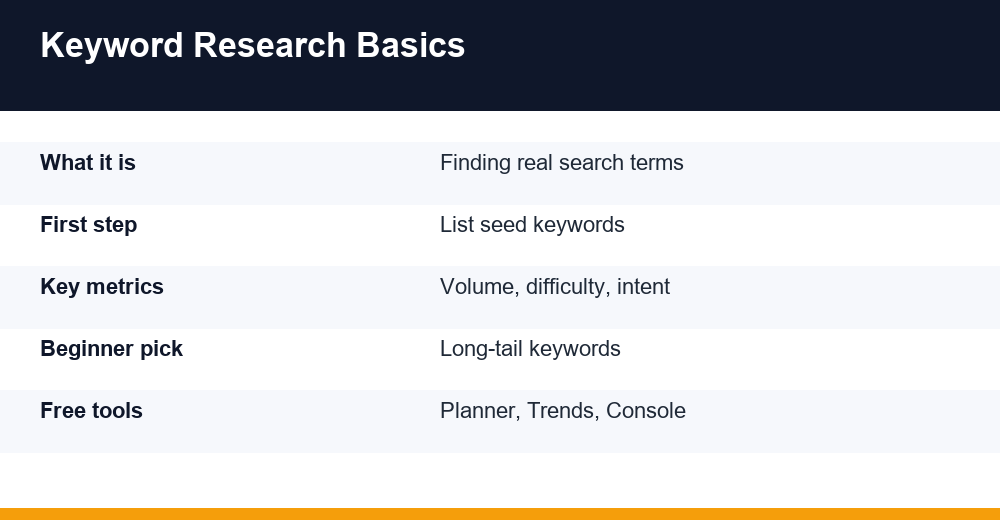
What Keyword Research Really Means
At its core, the practice is simple to describe: figure out which real search terms your audience uses, how many people use them, and how hard each one is to rank for — all before you write a single word. That order matters. Research first, then create.
Search has changed, and it is fair to ask whether the practice still matters. AI Overviews, People Also Ask boxes, and zero-click results now answer many queries right on the page, without a visit. But the underlying signal has not moved: people still phrase their needs as searches, and pages that clearly satisfy those searches still get read, ranked, and cited by AI answers. Skipping this step is how good content ends up invisible.
It is only one piece of a bigger picture. For how discovery connects to technical setup, on-page optimization, and off-site authority, see our complete SEO guide for 2026. Here, we stay focused on the discovery process itself.
Done well, this groundwork answers five questions before you commit a minute to writing:
- Whether real demand actually exists for a topic
- The exact language people use to describe it
- What the searcher truly wants — their underlying intent
- How competitive each term is for a site your size
- Which pages to build, and in which order
Step 1: Build a List of Seed Keywords
Seed keywords are the broad, obvious terms that describe what you do. If you ran a coffee subscription, your seeds might be coffee subscription, single-origin beans, and pour-over brewing. They are launch points, not final targets. Every project begins with a short seed list exactly like this.
You do not have to invent these from thin air. The best seeds come from places where your audience already talks, asks, and searches:
- Your own product knowledge and the words customers use in emails, calls, and support tickets
- Google autocomplete — start typing a seed and note every suggestion that appears
- The People Also Ask and Related searches blocks on any results page
- Competitor pages, navigation menus, and blog category names
- Community sites such as Reddit, Quora, and niche forums where real questions live
- The search bars on Amazon, YouTube, and Pinterest for product and how-to phrasing
Aim for ten to twenty seeds. In the next steps you will expand each one into dozens of specific variations using the tools covered later, so you do not need an exhaustive list yet — just a representative spread across the topics you want to own.
Step 2: Match Every Keyword to Search Intent
Before you judge any term by its numbers, ask what the person searching actually wants. Search intent is the most important filter in the entire process. A page that misreads intent will not rank, however many keywords it packs in, because search engines serve the format that satisfies the query.
There are four classic intent types. Matching each keyword to the right one tells you exactly what sort of page to build:
| Intent | What the searcher wants | Example query | Best page type |
|---|---|---|---|
| Informational | To learn or understand | how to brew pour-over coffee | Blog post or guide |
| Navigational | To reach a specific brand | vertical teams blog | Homepage or brand page |
| Commercial | To compare before buying | best coffee subscription 2026 | Comparison or review |
| Transactional | To buy or sign up now | buy single-origin coffee | Product or landing page |
The fastest way to confirm intent is to search the term yourself and study page one. Google already shows what it believes people want — if the top results are all how-to guides, a product page will struggle in that space. Google’s own SEO Starter Guide makes the same point: create content for people first, and match what they came to do.
The page-one layout gives intent away too. Shopping ads and product carousels signal buyers; featured snippets, videos, and People Also Ask boxes signal people who want to learn. Read those features before you settle on a format — Google has already tested what satisfies each query, so the live results page is the closest thing to a cheat sheet you will find.
Some terms are genuinely mixed — “coffee grinder” could be someone learning or someone buying. When intent is split, look at which format dominates the results and lean that way, or cover both angles cleanly in one well-structured page.
Step 3: Weigh Search Volume Against Difficulty
Two numbers drive most decisions from here. Most keyword research tools report a monthly search volume — roughly how many people search a term each month — and a difficulty score estimating how hard the first page is to break into.
The classic beginner trap is chasing the biggest volume. High-volume terms are usually locked up by established sites with years of authority and thousands of backlinks. A brand-new site that targets them tends to land on page five, where almost nobody scrolls. Volume without a realistic chance of ranking is just a vanity metric.
It helps to know how the scores work. Most tools rate difficulty on a scale of 0 to 100, where lower numbers mean weaker competition. The exact formula differs between tools, so a term rated 25 in one may read 35 in another. Treat the number as a signal rather than a verdict, and always confirm it by studying who currently ranks.
- Treat volume as relative, not precise — every tool estimates, so ranges matter more than exact counts
- Judge difficulty against your own site’s authority, never in the abstract
- Open the results page and size up who already ranks; the live competition is the real difficulty test
- Weigh volume against intent value — ten ready buyers can be worth more than a thousand casual browsers
For a new or small site the sweet spot is consistent: moderate demand, low difficulty, and an intent you can genuinely satisfy. Those are the terms that produce your first rankings, and early wins build the authority you need to chase bigger targets later.
Step 4: Go After Long-Tail Keywords First
Long-tail keywords are longer, more specific phrases — usually three or more words, and often full questions. Long-tail keywords carry lower search volume individually, but they face far less competition and reveal much clearer intent, which makes them the natural starting point for anyone building authority from zero.
The contrast is easy to see:
- Head term: coffee — enormous volume, brutal competition, vague intent
- Long-tail: best low-acid coffee for cold brew — modest volume, winnable, unmistakable intent
This is where beginners win. Specific pages rank faster, convert better, and compound: fifty focused pages, each pulling a steady trickle of qualified visitors, will out-earn one head term you never crack. They also suit AI search, which lifts direct answers from pages that address a precise question cleanly and completely.
Finding these is easy once you know where to look: expand seeds in autocomplete, harvest every People Also Ask question, scan a free suggestion tool for “how”, “best”, and “vs” variants, and mine your own Search Console for phrases you already appear for.
Long-tail pages rank with less off-site help, but the competitive head terms you eventually want will need real authority behind them — and that is where link building strategies earn their keep. Start narrow, prove you can rank, then climb toward the harder terms.
Free and Paid Tools for Finding Keywords
You do not need an expensive subscription to get going. Google’s free tools alone can carry you a surprisingly long way, and most paid platforms offer a limited free tier or free standalone tools so you can test their data before paying.
| Type | Examples | What you get | Cost |
|---|---|---|---|
| Google tools | Keyword Planner, Trends, Search Console | Volume ranges, trends, your real query data | Free |
| Free idea tools | Autocomplete, AnswerThePublic, Ubersuggest | Question and phrase ideas, rough metrics | Free / freemium |
| Freemium platforms | Semrush, Moz, Mangools | Volume, difficulty, intent, SERP data | Limited free tier |
| Paid platforms | Ahrefs, Semrush, Moz Pro | Big databases, competitor gaps, rank tracking | Subscription |
A quick, honest read on the options:
- Google Search Console is the most underrated free source — it shows the exact queries already earning you impressions, and the terms where you sit just off page one
- Free tools cover most of what a beginner needs in the first year of publishing
- Paid platforms mainly buy speed, scale, and competitor intelligence — well worth it once keywords become a weekly habit rather than a one-off task
The smartest setup is a small stack, not a single tool. Generate ideas with autocomplete and a free suggestion tool, sanity-check volume and difficulty in a freemium platform, then confirm real intent by reading the live results page yourself.
Step 5: Map Keywords to Pages and Build Your List
Now turn a messy pile of terms into a plan. Keyword mapping means assigning each target term — plus the cluster of variations around it — to one specific page. The rule of thumb is simple: one intent, one page.
Group closely related terms together. A single strong guide on pour-over coffee can target the main how-to phrase alongside a dozen related questions and variants; you do not need a separate page for each wording. Splitting near-identical terms across multiple pages makes them compete with one another — a self-inflicted problem known as keyword cannibalization.
Grouping this way is the seed of a topic cluster: one thorough pillar page for the broad term, supported by focused pages for the narrower questions around it, all linked together. That internal linking helps readers move between related pages and shows search engines how your coverage fits, which tends to lift the whole group rather than a single page.
The entire deliverable of keyword research is usually one simple spreadsheet. Give it these columns and keep it living:
- Primary keyword — the single term the page is built to win
- Search volume and difficulty, side by side
- Intent type, so the page format is never in doubt
- Target URL — the one page that owns this keyword
- Secondary keywords and questions to cover on the same page
- Priority — quick win, medium, or long-term
- Status — planned, published, or due for a refresh
Sort the sheet by priority and start with the quick wins: low difficulty, clear intent, and a page you can genuinely write well. That ordered list becomes your content roadmap for the next several months, and it keeps everyone working on the pages most likely to pay off first.
Common Mistakes That Waste Your Time
A handful of habits quietly waste the most effort. Watch for these, and you will get more from every hour you invest:
- Chasing raw search volume while ignoring intent and difficulty
- Judging difficulty in the abstract instead of against your own site’s authority
- Publishing one thin page per keyword rather than one thorough page per topic
- Stuffing keywords into copy — write for humans, since search engines now understand natural language
- Ignoring Google Search Console, which quietly lists the terms you already nearly rank for
- Copying a large competitor’s targets without the authority to back them up
- Doing the work once and never revisiting it as demand and your results shift
Done well, keyword research is less about clever tools and more about listening — to how your customers describe their problems, and to what the results page already rewards. Build the list, ship the pages, then check your data and refine. That loop, repeated patiently, is what compounds into lasting rankings.
Frequently Asked Questions
How long does keyword research take?
For a small site, a focused first pass takes a few hours: gather seed ideas, sort them by intent and difficulty, and map twenty to forty terms to real pages. Treat it as ongoing rather than one-and-done, though — revisit the list each quarter as demand, rankings, and search behavior keep shifting.
Do I need paid tools to find keywords?
No. Google Keyword Planner, Trends, Search Console, and plain autocomplete are free and more than enough to launch. Paid platforms like Ahrefs or Semrush mainly save time and add competitor data once you scale up, but they are not required to start researching terms and ranking pages.
What counts as a good search volume?
There is no universal number. On a young site, a keyword with modest volume and low difficulty usually beats a high-volume term you cannot realistically rank for. Judge volume against intent value too — a handful of ready-to-buy searches often outperforms thousands of purely casual ones.
How many keywords should one page target?
One primary term plus a cluster of closely related variations and questions. Modern search engines read topics rather than single phrases, so a page that covers one intent thoroughly can rank for dozens of terms. Splitting nearly identical keywords across separate pages usually just makes them compete.