Link building remains one of the most dependable ways to earn Google’s trust, yet many tactics that worked five years ago now range from useless to genuinely risky. This guide covers 12 white-hat strategies that still move rankings in 2026, ranked roughly by the effort each demands and the payoff it delivers. No shortcuts and no schemes, just methods that hold up to scrutiny.
Table of Contents
Why Links Still Matter in 2026
Google has spent years emphasising content and user experience, and both genuinely matter. But links remain a core ranking signal because they are hard to fake at scale and they tell search engines which pages the wider web actually trusts. In an age of AI-generated content flooding every niche, an editorial endorsement from a real, respected site is worth more than ever. Think of every quality link as a recommendation you didn’t have to write yourself.
What has shifted is the margin for error. Google’s systems are far better at spotting manipulation, and a burst of low-quality links can now drag you down instead of lifting you up. Effective link building in 2026 looks less like a numbers game and more like digital PR: earning coverage, relationships and mentions that happen to carry a link.
Links also feed the experience, expertise, authoritativeness and trust signals Google leans on to judge who deserves visibility. A citation from a recognised source in your field is one of the clearest ways to show you belong in that conversation, which is why honest tactics have never been better rewarded. Businesses that publish genuinely useful resources and pitch them well now pull clear of rivals still trying to buy their way up.
What Makes a Link Worth Earning
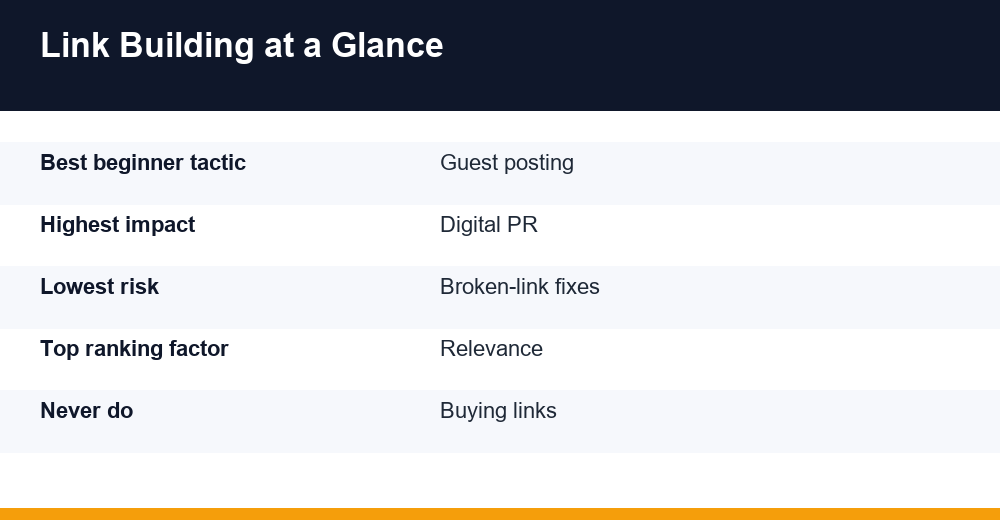
Before chasing a single link, understand what separates a valuable one from a waste of time. Search engines read links as votes of confidence, but those votes are weighted heavily. One relevant, editorially given link can outperform hundreds of directory submissions or paid placements. Volume for its own sake is a trap; a lean profile of strong links beats a bloated one every time.
Off-page work also depends on your own house being in order. If pages load slowly or crawlers can’t reach them, backlinks won’t rescue your rankings, so pair outreach with the fixes in our technical SEO checklist. For the wider picture of how links sit alongside content and site health, our complete SEO guide for 2026 maps out where each piece fits.
Judge every opportunity against four questions:
- Relevance — does the linking site cover topics close to yours?
- Authority — has that domain earned credible links of its own?
- Placement — does the link sit inside the main content, not a footer or author-bio farm?
- Traffic — could a real reader plausibly find and click it?
Anchor text matters too, mainly by staying natural. Healthy profiles lean on branded and bare-URL anchors, with descriptive phrases mixed in; a rush of exact-match keyword anchors from unrelated sites is a classic manipulation signal. When you can influence the wording, choose a phrase that describes the destination honestly rather than one stuffed with your target term.
If a prospect fails the first two tests, walk away. A link nobody would click and search engines don’t respect isn’t worth the outreach email it would take to land it.
12 Link Building Strategies That Work in 2026
Here are the tactics worth your time this year, arranged roughly from lowest to highest lift. The strongest link building programs blend three or four of these rather than betting everything on one channel, so treat the list as a menu, not a checklist. Match the tactics to your resources, your industry and how quickly you need results.
1. Guest posting on relevant publications
Pitch original, genuinely useful articles to established sites in or next to your niche. The aim isn’t the link alone but exposure to a relevant, engaged audience. Skip the low-quality ‘write for us’ networks that publish almost anyone; one thoughtful post on a respected industry blog is worth more than twenty on content farms Google already discounts. The best opportunities are ones where you’d want the traffic even if the link were nofollow.
2. Digital PR campaigns
Create something newsworthy, such as a survey, a striking data point or a timely reaction to industry news, then pitch journalists who cover your space. Done well, a single campaign can earn dozens of links from high-authority news outlets, plus brand awareness ordinary outreach can’t buy. Even a modest local-news pickup can send authority signals a hundred directory links never would. It has the highest ceiling of any tactic here.
3. Expert quotes and journalist requests
Reporters constantly need expert sources. The long-running HARO service (later rebranded Connectively) shut down in December 2024, but the model lives on through platforms such as Featured, Qwoted, Source of Sources and SourceBottle, where you answer relevant queries and earn a quoted mention with a link. Reply quickly, stay specific, and pitch only topics you genuinely know.
4. Original research and linkable assets
Publish something people cite: a benchmark study, an original survey, a free calculator or a definitive statistics page. Original data is among the most link-worthy assets you can own, because writers need sources, and once yours becomes the one they reference, it keeps attracting links for years with little extra effort. Promote it once, then let journalists and bloggers do the linking for you.
5. Resource page outreach
Plenty of sites maintain curated ‘best resources’ pages for their readers. Find ones relevant to your topic, confirm your content honestly deserves a place, then email the owner to suggest it. Because you’re improving their page rather than asking a pure favour, acceptance rates are far better than cold pitching.
6. Broken-link reclamation
Scan authoritative pages in your niche for dead outbound links, create or identify a comparable resource of your own, and let the site owner know their link is broken while offering yours as the fix. You’re doing them a favour, which makes this one of the lowest-risk, highest-response tactics around.
7. The skyscraper technique
Find a popular piece that has already attracted plenty of links, build something clearly better (more current, more thorough, better designed), then reach out to the sites linking to the original. It only works when your version is a real upgrade, not a lightly reworded copy of what already exists.
8. Unlinked mention reclamation
Brands get named without a link all the time. Use monitoring tools to find places your company, product or research is mentioned but not linked, then send a friendly note asking the author to make the mention clickable. These are among the easiest, fastest links you’ll ever earn.
9. Strategic internal linking
The links you fully control are your own. Point authoritative pages on your site to the ones you want to rank, using clear, descriptive anchor text. Internal links spread ranking power across your site, help Google understand your structure, and cost nothing but a few minutes per published article. It’s also the fastest way to get new pages discovered and indexed.
10. Podcasts, interviews and expert roundups
Appearing as a guest on a podcast or contributing to an expert roundup usually earns a link from the show notes or article, plus a warm, relevant audience. Pitch hosts with a specific angle their listeners will value, not a generic ‘I’d love to come on the show’ that lands in the bin.
11. Testimonials and case studies
Companies love displaying customer testimonials, often with a link back to the reviewer’s site. If you genuinely use a tool or service, offer an honest testimonial. In the same vein, letting a vendor feature you in a case study can earn a link from a high-authority domain you’d struggle to reach otherwise.
12. Free tools, templates and calculators
A simple but genuinely useful free tool, such as a calculator, generator or template, attracts links passively for years. It takes more to build than a blog post, but people link to tools they actually use far more readily than to articles they merely skim. Round it out with a short explainer page so it can rank and earn links in its own right.
| Tactic | Effort | Typical timeline | Best for |
|---|---|---|---|
| Guest posting | Medium | Weeks | Steady, relevant links |
| Digital PR | High | Weeks–months | Authority and brand lift |
| Expert quotes | Low | Days–weeks | Fast, cited mentions |
| Original research | High | Months | Passive, lasting links |
| Resource pages | Low | Weeks | Niche relevance |
| Broken-link reclamation | Medium | Weeks | Low-risk wins |
| Skyscraper technique | High | Weeks–months | Competitive niches |
| Unlinked mentions | Low | Days | Quick, easy links |
| Internal linking | Low | Ongoing | Full control |
| Podcasts and roundups | Medium | Weeks | Relationships and reach |
| Testimonials | Low | Days–weeks | Simple authority links |
| Free tools | High | Months | Long-term link magnet |
Notice the pattern: none of these require tricking anyone. Every link is earned because you offered something real, whether a resource, an insight, a fix or a genuine relationship.
Link Schemes and Tactics to Avoid
Knowing what to avoid matters as much as knowing what to do. Google’s guidelines are blunt: any link created primarily to manipulate rankings breaks its policies, and the downside rarely justifies the upside. A single manual action can erase years of progress, and recovery is slow and uncertain.
Steer clear of these entirely:
- Buying or selling links that pass ranking signals, including ‘sponsored’ placements with no nofollow or sponsored tag
- Private blog networks (PBNs), sites built for the sole purpose of linking to your money pages
- Large-scale link exchanges, the old ‘link to me and I’ll link to you’ trade
- Automated links and spun content from software, plus low-quality bulk directories
- Forum, comment and profile spam stuffed with exact-match anchor text
The common thread is intent. A paid placement is perfectly fine for traffic and awareness, as long as the link is marked nofollow or sponsored. Google spells out the boundaries in its spam policies documentation, and its systems now neutralise most manipulative links automatically, so the effort is usually wasted long before any penalty arrives.
If you’ve inherited a toxic profile from past link building, the fix is usually to earn quality links that outweigh the bad ones. Reach for the disavow tool only when you can see a clear, manual pattern of spam you genuinely can’t get removed; Google says most sites never need it.
Building an Outreach Process That Scales
Most tactics above depend on outreach, and outreach succeeds or fails on relevance and personalisation. A generic mass email gets deleted; a short, specific note that proves you actually read the person’s work gets replies. Build a repeatable process so quality doesn’t slip as volume grows.
- Build a qualified prospect list of sites that are relevant, active and realistically likely to link
- Find the right contact, usually the author or editor, not a generic ‘info@’ inbox
- Lead with what’s in it for them: a fix, a resource or genuinely useful content
- Keep the first email short, and follow up once, politely, after a few days
- Log every pitch in a simple sheet so nothing slips and you can track reply rates
Tools like Ahrefs, Semrush and Pitchbox speed up prospecting, monitoring and follow-ups, but they don’t replace judgment. The teams that consistently win at link building treat it as relationship building; the links are a by-product of being useful, credible and easy to work with.
How to Measure Your Results
Links are a means, not the end. Track them alongside the outcomes they’re meant to drive, so you can tell what’s genuinely working from what merely feels productive.
- Referring domains — the count of unique sites linking to you matters more than raw link totals
- Relevance and authority of new links, not simply how many landed
- Rankings for your target keywords, tracked over time
- Referral traffic, since links that send real visitors are pulling double duty
- Reply and placement rates on outreach, so you can sharpen your pitches
A simple stack covers most of this. Google Search Console reports the links Google actually counts, alongside impressions and clicks; a rank tracker follows your target keywords; and a backlink tool such as Ahrefs, Semrush or Moz tracks referring-domain growth over time. Confirm each new link is live, indexed and pointing where you intended before you count it as a win.
Give it time. Link results compound over months rather than days, and search engines need to recrawl and reassess before the effect shows. Set expectations with clients and stakeholders early, so a slow first month doesn’t read as failure. Review quarterly, double down on the tactics earning relevant links efficiently, and quietly retire the ones that aren’t paying off.
Do that consistently, keep quality ahead of quantity, and your authority and rankings will grow on a foundation that holds steady through routine algorithm updates.
Frequently Asked Questions
How long does link building take to show results?
Expect movement over months, not weeks. New links must be crawled and reassessed, and their effect compounds as your authority grows. Most sites see meaningful ranking shifts three to six months into a consistent, quality-focused campaign, faster in low-competition niches and slower in crowded ones.
Are backlinks still a ranking factor in 2026?
Yes. Google still treats links as a core signal of trust and authority, alongside content quality and user experience. What has changed is enforcement: manipulative links are neutralised or ignored, while relevant, editorially earned links carry as much weight as ever.
How many backlinks do I need to rank?
There is no fixed number. Relevance and quality outweigh volume, so a handful of links from authoritative, on-topic sites can beat hundreds of weak ones. Study the pages already ranking for your keyword to gauge a realistic bar, then focus on closing the gap with better links.
Is buying backlinks safe?
No. Paying for links that pass ranking signals violates Google’s guidelines and risks penalties or having the links simply ignored. If you sponsor a placement for traffic or awareness, mark it nofollow or sponsored. Earning links through useful content is slower but far safer.