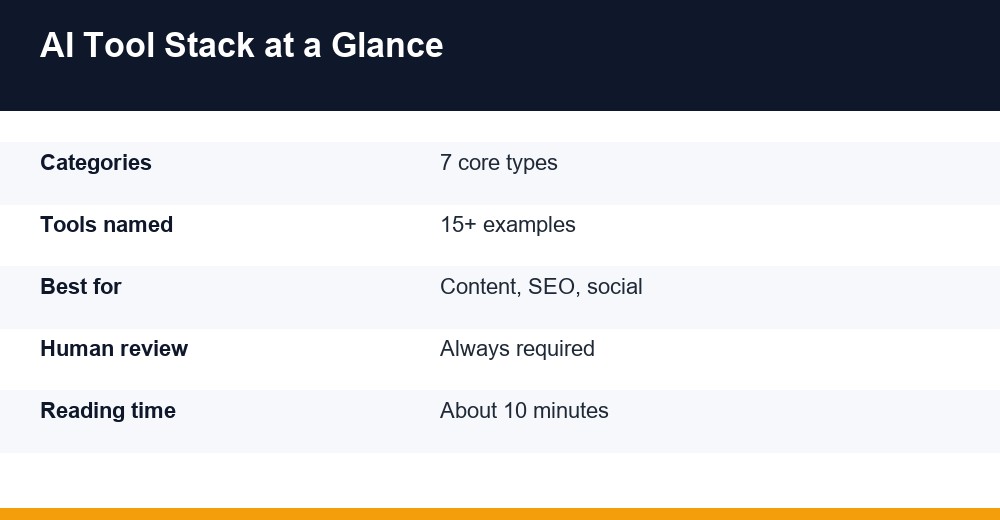
The market for ai marketing tools has grown from a handful of novelty apps into a crowded field of hundreds of platforms, and separating the genuinely useful from the hype is now a job in itself. This guide skips the fifty-item mega-lists and instead walks through the seven categories that matter, names the standout tools in each, and explains where these systems still need a steady human hand.
Table of Contents
Why AI Belongs in Your Marketing Stack
Marketing has always rewarded speed and volume, and that is exactly what machine learning does well. Today’s software can draft a month of social posts before lunch, group thousands of keywords by search intent, or flag the subject line that is costing you email opens. None of this replaces judgment, but it clears the grind that used to swallow a marketer’s afternoon and frees you for work that moves the numbers.
The framing is simple. AI is a force multiplier for people who already know what good looks like. Give it to a sharp marketer and it compounds their output; give it to someone without a plan and it produces a great deal of confident, forgettable noise. Every product here is only as valuable as the brief, the data, and the review you wrap around it.
Adoption has moved from experiment to expectation. Industry surveys consistently show that most marketing teams now use AI in some form, most often for content creation and research. The useful question is no longer whether to adopt it, but where it earns its keep and where it creates more cleanup than it saves.
Where it helps most
- Repetitive production — first drafts, ad variations, resizing, and reformatting one asset for different channels.
- Pattern-finding — spotting anomalies in data, segmenting audiences, and summarizing long reports in seconds.
- Scale — personalizing messages at volumes no human team could match by hand.
Where it still stumbles
- Facts and figures — anything stated as true needs checking against a primary source.
- Brand voice — output drifts toward a generic, polished register without a human edit.
- Judgment calls — strategy, positioning, and taste stay firmly human.
The Main Categories of AI Marketing Tools
Before naming products, it helps to see the shape of the field. Nearly every platform on the market falls into one of seven buckets. Most teams need only two or three of them, and recognizing the categories is the simplest way to avoid paying twice for the same underlying feature.
| Category | What it does | Example tools | Watch out for |
|---|---|---|---|
| Content & copy | Drafts articles, ads, emails | Jasper, Copy.ai | Generic tone, factual slips |
| SEO | Keyword and on-page help | Semrush, Surfer | Over-optimization |
| Image & video | Generates and edits visuals | Canva, Midjourney | Rights and consistency |
| Social scheduling | Plans and posts content | Buffer, Hootsuite | Loss of brand voice |
| Analytics | Surfaces insights and reports | GA4, Improvado | Correlation vs cause |
| Chatbots | Answers and qualifies leads | Intercom, Tidio | Confident wrong answers |
| Personalizes send and content | Klaviyo, Seventh Sense | Data quality, creepiness |
The strongest ai marketing tools in each row share one trait: they do a single job unusually well instead of doing everything adequately. All-in-one suites that promise every category at once tend to be shallow in the exact areas you care about most, so weigh depth against convenience before you commit.
Two patterns cut across all seven categories. These tools improve fastest where the task is repetitive and low-stakes, and they struggle most where judgment, nuance, or accountability are required — a useful map for deciding what is safe to hand over and what is not.
Content and Copywriting Tools
This is the category that made AI famous, and it is still where most teams begin. Purpose-built writers like Jasper and Copy.ai turn a short brief into blog drafts, ad copy, product descriptions, and email sequences, and both include brand-voice settings that keep the output roughly on tone.
General assistants such as ChatGPT, Claude, and Gemini are cheaper, more flexible, and often just as capable for one-off drafting, outlining, and rewriting. They now offer memory and custom instructions, yet the dedicated tools still earn their premium through marketing templates, team workflows, and saved brand context you would otherwise re-enter each session.
Cost varies widely. General assistants start free or near it; dedicated marketing writers charge monthly per seat and climb with word limits and team features. Match the plan to real volume — paying for unlimited words you never use is one of the most common wasted line items in a marketing budget.
Output quality tracks input quality almost exactly. A vague prompt returns vague copy, while a brief that includes your audience, goal, key points, and a sample of past writing returns something you can actually edit. Feeding a tool your style guide or a few strong examples does more for consistency than any premium feature on the pricing page.
Whatever you pick, a fast first draft is not a finished asset. The copy still has to live inside a real content marketing strategy — with a defined audience, a genuine point of view, and an editor who trims the filler and hedging these models love to add.
- Strong for: first drafts, subject-line variants, and repurposing one asset into many.
- Weak for: original research, sensitive claims, and anything that needs real lived expertise.
SEO and Search Optimization Tools
AI now underpins most SEO software. Semrush and Surfer SEO analyze the pages already ranking for your target term, then show which subtopics, questions, and phrases your draft is missing so it has a chance of competing.
Clearscope and similar content-grading tools do much the same behind a cleaner interface, scoring your writing against the current top results in real time. Used well, they cut research time sharply; used blindly, they nudge every site toward the same bland, over-optimized page that reads like it was written to a checklist.
These tools optimize a page; they cannot fix a weak site. Pair any of them with a solid technical and structural base — our complete SEO guide for 2026 covers the fundamentals that software still cannot automate away.
One shift worth planning for now: search itself is turning into an AI product. As AI Overviews and chat answers absorb clicks that once went to the ten blue links, the goal moves from merely ranking to being cited. Clear answers backed by real sources are what these systems tend to surface.
A practical tip: use these tools for the outline and the gap analysis, then write the substance yourself. That order keeps the human insight that ranks well and still captures the efficiency the software offers, without producing the interchangeable pages search engines are increasingly happy to ignore.
Image, Video and Social Scheduling Tools
On the visual side, Canva Magic Studio folded generative images, background removal, and instant resizing into a tool non-designers already knew, which is why it spread so quickly. Midjourney remains the pick for higher-craft, original imagery when you have someone able to direct it with precise prompts.
For distribution, schedulers such as Buffer and Hootsuite now layer on AI that recommends posting times, drafts captions, and reshapes one post for several networks at once. The convenience is real, yet identical auto-captions across every channel are easy to spot, so keep a human voice on the accounts that actually matter.
A workflow that holds up: generate several rough options fast, pick the one closest to your brand, then finish it by hand in an editor you trust. Treating AI output as a starting sketch rather than a finished render is what keeps generated visuals from looking mass-produced.
Two cautions travel with generated visuals. Commercial usage rights differ by tool and plan, so read the license before an image goes on a paid ad. And consistency is hard to control — models rarely reproduce the same character or product twice, which frustrates brand-heavy work that needs a repeatable look.
Video is the fast-moving frontier. Tools that generate short clips, add captions, or turn a blog post into a talking-head reel are improving monthly, though results still range from impressive to uncanny, so always preview before you publish anything customer-facing.
- Great for: resizing, first-pass captions, and turning a single idea into many formats.
- Risky for: brand-defining hero images and anything presented as a real photograph.
Analytics, Chatbots and Email Personalization
Analytics is where AI does some of its least glamorous but most useful work. Platforms such as Google Analytics 4 and data aggregators like Improvado surface anomalies, plain-language summaries, and simple forecasts that would take an analyst hours to assemble by hand from raw exports.
On the conversational front, chatbots like Intercom and Tidio handle routine questions and qualify leads around the clock. They are excellent at deflecting repetitive tickets and notably poor at edge cases, so a clean, obvious handoff to a real person is non-negotiable rather than optional.
Email is the quiet winner of the group. Klaviyo and send-time optimizers such as Seventh Sense tailor content and timing to each subscriber, lifting opens and revenue without any new creative. The catch is data: personalization is only as good as the list behind it, and it curdles into creepiness the moment that data is wrong.
Attribution stays the honest weak spot. AI reporting is superb at describing what happened and shaky at explaining why it happened, so treat its confident causal claims as hypotheses worth testing, not conclusions worth banking on.
For most small teams, the AI already built into tools you pay for — your email platform, ad accounts, and analytics — covers the essentials before you buy anything dedicated. Exhaust those first; they cost nothing extra and already hold your data.
The Limits: Accuracy, Oversight and Brand Risk
Now the part most listicles skip. Even the best ai marketing tools will state things that are simply untrue, in fluent and confident prose. These models predict likely words rather than verified facts, so invented statistics, fabricated features, and misremembered prices are a permanent characteristic, not a passing bug.
That matters more in marketing than almost anywhere else, because your output is public and tied to a brand. A hallucinated claim in an ad, or a wrong figure in a client report, can cost you trust or worse. Search engines have noticed too — Google’s guidance on AI-generated content rewards genuine helpfulness and filters out mass-produced filler.
Brand voice is the other quiet cost. Left unchecked, several of these tools drift toward the same polished, slightly hollow register, and audiences are learning to recognize it on sight. A short editing pass that adds specifics, opinions, and real examples is what separates AI-assisted work from AI-generated sludge.
Disclosure norms are tightening as well. Some clients and platforms now expect AI-generated or AI-assisted work to be labelled, and the rules vary by industry and region. Checking your client contracts and each platform’s policy before you scale AI output is far cheaper than untangling a complaint after the fact.
Three safeguards keep you out of trouble:
- Review everything public before it ships — treat every output as a draft, never a final.
- Verify each fact, figure, and claim against a primary source you actually trust.
- Mind your data — know what a tool stores, and never paste confidential or customer information into a public model.
How to Choose Without Overspending
With hundreds of options and new launches every week, the real trap is collecting subscriptions you barely open. When you evaluate ai marketing tools, start with the job to be done, not the brand on the box or the longest feature list.
- Name the bottleneck first — slow drafts, thin reporting, missed posting times — then shop for that single job.
- Prefer a specialist over a suite when the task is central to your work, because specialists usually go deeper.
- Run the free trial on a real task, not a demo, and measure the time or money it genuinely saves.
- Check integrations so a new tool feeds your existing stack instead of creating another data silo.
The table below maps a common bottleneck to the category worth shopping first, with a free or low-cost option to test before you commit to a paid plan.
| Your bottleneck | Category to shop | Try first |
|---|---|---|
| Slow content drafts | Writing assistant | ChatGPT, Claude, or Gemini free tier |
| Pages not ranking | SEO / content grader | A Surfer or Semrush trial |
| Missed posting times | Social scheduler | Buffer’s free plan |
| Thin, manual reporting | Analytics AI | GA4’s built-in insights |
| Flat email engagement | Email personalization | AI already in your ESP |
A sensible starting stack for most small teams is one writing assistant, one SEO tool, one scheduler, and whatever analytics your platforms already include — typically well under a few hundred dollars a month combined, and often much less.
Finally, review the stack on a schedule. Set a calendar reminder each quarter to audit every subscription: what you used, what it replaced, and what you forgot you were paying for. Tool sprawl is a slow leak, and a ten-minute review usually plugs it.
Done right, your set of ai marketing tools should feel almost invisible: fewer late nights, cleaner reports, and more time for the strategy, creativity, and relationships that software still cannot fake.
Frequently Asked Questions
Are AI tools worth it for a small business?
Usually yes, if you start small. One writing assistant and one scheduler can save hours a week for a modest monthly cost. The value comes from the time you reclaim, not from owning every tool, so add them one bottleneck at a time.
Can AI replace a marketing team?
No. These tools speed up production and analysis, but they have no strategy, taste, or accountability. They draft and suggest; people decide, edit, and own the results. Treat them as a fast junior assistant who needs a clear brief and careful review, not a replacement hire.
Will AI-written content hurt my SEO?
Not by itself. Google judges content by helpfulness, not by how it was made. Thin, mass-produced pages get filtered whether a person or a model wrote them. Use AI to draft, then add real expertise, original detail, and a careful edit, and the page can rank perfectly well.
How much should I budget for AI tools?
Most small teams run a useful stack for well under a few hundred dollars a month, often less. Start with free trials, keep only what earns its place, and review subscriptions each quarter so unused tools do not pile up unnoticed.