Email list building is the most dependable way to own your audience instead of renting attention from an algorithm that can change overnight. Subscribers are people who explicitly asked to hear from you, so you can reach them directly and repeatedly without paying for every impression. This guide covers ten ethical, proven tactics to grow your list in 2026, plus the opt-in mechanics and consent rules that protect your sender reputation.
Table of Contents
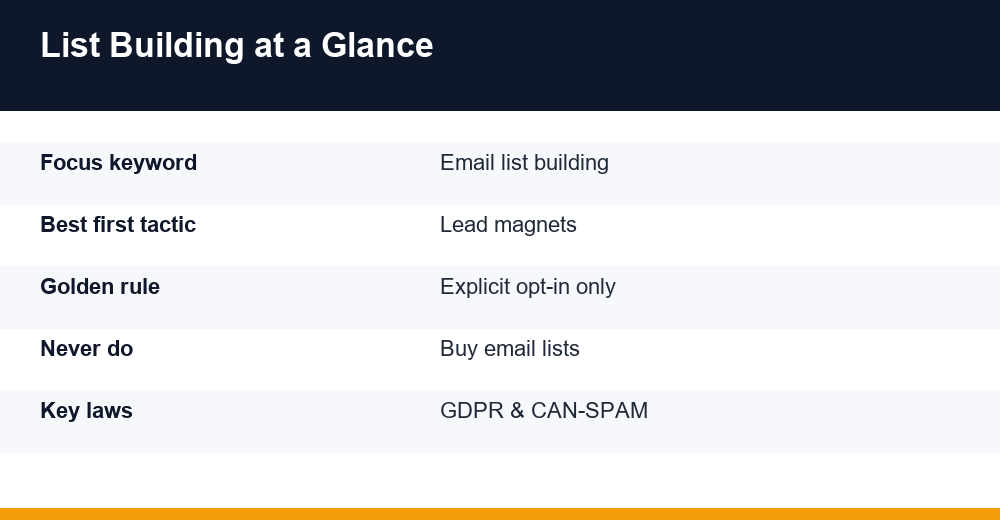
Why Email List Building Beats Rented Audiences
Social platforms lend you an audience; your email list is one you truly own. Organic reach on social is throttled by ranking algorithms and shifting policies, while a healthy list lets you reach every subscriber whenever you have something worth saying. That control is why email list building consistently outperforms chasing followers.
The economics are hard to argue with. Email is a direct channel with no gatekeeper taking a cut per message, which is why the ROI of email marketing remains among the strongest in digital marketing. Every subscriber you add compounds over time: they can buy more than once, forward your emails, and give you first-party data that grows more valuable as third-party cookies disappear.
There is a catch. A list is only an asset if the people on it genuinely want your emails. Volume without permission produces spam complaints, weak open rates, and poor deliverability, so quality has to lead from day one. A small, engaged list will nearly always out-earn a large, indifferent one.
An email list is also portable. You can export it, switch providers, and keep the relationship intact if a tool raises its prices or shuts down. Few marketing assets give you that freedom, which is why an owned audience underpins almost every durable growth strategy.
10 Proven Ways to Grow Your List Fast
The tactics below span the full spectrum of email list building, from quick wins you can ship this week to bigger plays that pay off over months. Use the table to pick two or three that fit your traffic and resources, then go deep on those rather than trying all ten at once.
| Tactic | Best for | Effort | Typical yield |
|---|---|---|---|
| Lead magnet download | Most websites | Medium | High |
| Content upgrade | Blogs & publishers | Low | High |
| Inline & footer forms | Every page | Low | Steady |
| Exit-intent popup | High-traffic pages | Low | High |
| Dedicated landing page | Campaigns & ads | Medium | High |
| Webinar or workshop | B2B & experts | High | High quality |
| Quiz or free tool | Ecommerce & SaaS | High | High |
| Referral incentive | Existing subscribers | Medium | Compounding |
| Checkout opt-in | Ecommerce | Low | Steady |
| Offline & cross-channel | Events & social | Medium | Variable |
Here is what each of the ten looks like in practice:
- Lead magnets — a checklist, template, or short guide people trade their email for. The backbone of most lists.
- Content upgrades — a bonus tied to a specific post, such as a worksheet attached to a how-to article, offered right where readers are already engaged.
- Inline and footer forms — unmissable, low-friction signup boxes placed inside your content and in the site footer.
- Exit-intent and timed popups — one well-timed offer that appears as a visitor is about to leave or after they have read for a while.
- Dedicated landing pages — distraction-free pages built around a single offer, ideal for ad traffic and partnerships.
- Webinars and live workshops — teach something valuable live; registration is the opt-in and attendees arrive warm.
- Quizzes, calculators, and free tools — interactive value that captures an email to deliver a personalized result.
- Referral incentives — reward subscribers for forwarding your emails or sharing a signup link with peers.
- Checkout and account opt-ins — a clearly labeled subscribe checkbox during purchase or signup, never pre-ticked.
- Offline and cross-channel capture — QR codes at events, a link in your social bios, and guest posts or podcast mentions that point to a landing page.
If you are just starting out, begin where you already have attention. Add a form to your most-read post, launch one lead magnet, and only then layer on popups, landing pages, or webinars. Chasing every channel at once usually means none of them gets the testing it needs to actually work.
Whichever tactics you choose, tag each subscriber with the source that brought them in. Some channels deliver signups that never open an email, while others bring genuine buyers. Tracking the source shows you where to invest, so you can double down on quality rather than chasing raw numbers.
Lead Magnets People Actually Want
A lead magnet earns the trade only if it solves one specific, urgent problem quickly. Broad ebooks and vague newsletter sign-ups underperform because they promise effort, not relief. Aim for something a reader could act on within ten minutes of downloading, and describe the exact outcome they will get.
The formats that tend to convert best are narrow and immediately useful:
- Checklists and cheat sheets — condense a process into steps someone can follow today.
- Templates and swipe files — hand over the finished framework, not the theory behind it.
- Short, specific guides — ‘the 5-email welcome sequence,’ not ‘everything about email.’
- Toolkits, calculators, and quizzes — interactive results feel personalized and worth the email.
- Free trials, samples, or a first-order discount — strongest for ecommerce and SaaS.
Match the magnet to the page. Someone reading about paid ads wants an ad-budget calculator, not a generic PDF. That relevance is where a broader content marketing strategy pays off: each genuinely useful article becomes a natural home for a tightly matched offer. Deliver the magnet instantly, then follow with a short welcome sequence so the relationship starts strong instead of going quiet.
Resist the urge to gate every resource. Some of your best content should stay free and public to build trust and earn search traffic; reserve the opt-in for the deeper, ready-to-use asset. A helpful free article that ends with a matched download almost always beats hiding everything behind a form.
Do not assume your first idea is the winner. Run two or three magnets against similar traffic and keep the one with the highest signup rate and the best follow-through. A magnet that attracts sign-ups but not buyers is a signal to sharpen either the offer or the audience you are targeting.
Opt-In Forms and Popups Done Right
Where and how you ask matters as much as what you offer. Keep forms short — an email address alone converts best, and every extra field costs you sign-ups. Add a name or one qualifying question only when you will actually use it to segment your list later.
Placement beats volume. Put opt-in forms where attention already lives:
- Inside and at the end of blog posts, where readers finish engaged.
- In the site footer and a slim header bar, so they stay visible site-wide.
- On your about page or a resources hub, where visitor intent runs high.
Popups work, but only when they respect the visitor. Trigger them on exit intent or after a reader has scrolled or spent real time on the page, never the instant someone lands. Cap the frequency so returning visitors are not nagged, make the close button obvious, and design carefully for mobile, where Google can penalize intrusive interstitials that block the content someone came to read.
Every form needs a clear value proposition (‘Get the weekly playbook,’ not just ‘Subscribe’) and a single, obvious call to action. Test one variable at a time, whether that is the headline, the offer, or the button copy, so you learn what actually moves your conversion rate instead of guessing.
Speed and accessibility quietly shape conversion too. A form that loads slowly, shifts the layout as it appears, or is fiddly to tap on a phone loses people before they read your offer. Label fields clearly, size tap targets generously, and confirm each signup with an on-screen message rather than a silent redirect.
Landing Pages, Webinars, and Content Upgrades
For campaigns, ads, and partnerships, send traffic to a dedicated landing page rather than your homepage. Strip out the navigation, focus on one offer, lead with the benefit, and add a short proof element such as a testimonial or a preview of what subscribers receive. Fewer choices reliably mean higher conversion.
Webinars and live workshops are among the highest-quality ways to grow a list. Registration is the opt-in, and people who give you an hour of their attention arrive far warmer than a cold PDF download. Record the session and turn it into an evergreen replay that keeps collecting sign-ups long after the live date has passed.
One recorded webinar can feed months of growth. Clip it into short videos, turn the transcript into blog posts, and gate the full replay behind a form. Each spin-off points back to the same signup page, so a single afternoon of teaching keeps compounding into new subscribers.
Content upgrades deserve special mention because they convert so well. Instead of a site-wide offer, attach a bonus to a single high-traffic post: a checklist for a how-to guide, a spreadsheet for a tutorial, a template for a framework you explained. The reader is already interested in that exact topic, so the ask feels like a natural next step rather than an interruption.
Permission and Consent: GDPR and CAN-SPAM
Consent is the foundation of ethical email list building, and in most markets it is also the law. The rules vary by region, but the safe standard is simple: only email people who clearly chose to hear from you, and always make leaving easy.
Two frameworks cover most businesses:
- GDPR (EU and UK) requires freely given, specific, and informed consent. No pre-ticked boxes, and you must be able to show when and how each person opted in.
- CAN-SPAM (US) requires accurate ‘from’ and subject lines, a valid physical mailing address, and a working unsubscribe link that you honor promptly.
Single opt-in adds a subscriber the moment they submit the form. Double opt-in sends a confirmation email they must click first, an extra step that trims your numbers slightly but keeps out typos, bots, and spam traps while improving deliverability. For most lists, double opt-in is worth it. When you are unsure of the requirements, the FTC’s official CAN-SPAM compliance guide is the authoritative reference for US senders.
A preference center helps you keep consent healthy over time. Let subscribers choose topics and frequency instead of facing an all-or-nothing unsubscribe. People who can dial things back often stay on your list, and giving them that control is exactly the kind of respect that both regulators and inbox providers reward.
Whatever you choose, keep a clear record of consent, honor unsubscribes immediately, and never repurpose an address for a message the person did not agree to receive. Trust is slow to build and quick to lose.
What to Avoid and How to Measure Growth
The fastest way to sabotage months of work is to buy a list. Purchased and scraped addresses never consented to hear from you, so they mark you as spam, trigger the spam traps hidden on those lists, and can wreck the sender reputation you rely on to reach the subscribers you earned honestly. In GDPR regions, emailing bought contacts can also carry real financial penalties.
A few other habits quietly erode list quality:
- Pre-ticked consent boxes or burying the opt-in in fine print.
- Adding people who gave you their address for a different reason, such as a receipt or a support ticket.
- Letting the list decay by never cleaning hard bounces or re-engaging inactive subscribers.
Grow deliberately by watching a handful of numbers, not just the total subscriber count:
| Metric | What it tells you | Healthy direction |
|---|---|---|
| Signup conversion rate | How well pages and forms convert | Rising |
| List growth rate | Net new subscribers over time | Steady, positive |
| Bounce rate | Invalid or dead addresses | Low |
| Spam complaint rate | Whether people want your email | Very low |
| Unsubscribe rate | Content and frequency fit | Low and stable |
Engagement is the metric behind all the others. A prompt welcome sequence, a consistent sending rhythm, and content that matches what people signed up for keep opens high and complaints low. Mailbox providers watch those signals closely, so an engaged list is also a more deliverable one.
A simple sunset rule keeps quality high as you scale. If a subscriber has not opened or clicked in roughly six months, move them into a re-engagement flow, then remove them if they stay silent. This protects your engagement rates and ties your sending costs to people who genuinely read you.
Prune inactive subscribers periodically, but try to win them back with a re-engagement email first; a smaller engaged list beats a bloated one that lands in spam. Treat email list building as a long game. Permission-first growth, tended consistently, is what turns a simple list into your most valuable marketing asset.
Frequently Asked Questions
How long does it take to build an email list?
There is no fixed timeline; it depends on your traffic and your offer. With steady visitors and one strong lead magnet, you can gather your first few hundred subscribers within weeks. Consistency matters far more than any single launch, and most lists grow gradually and compound over months.
Should I ever buy an email list?
No. Bought lists contain people who never agreed to hear from you, so they generate spam complaints, hit spam traps, and damage your sender reputation. In GDPR regions they also carry legal risk. Every tactic in this guide grows a list that genuinely wants your emails.
Is double opt-in better than single opt-in?
Usually, yes. Single opt-in adds subscribers instantly but lets in typos and bots. Double opt-in asks for one confirmation click, so your list stays smaller but cleaner, with stronger deliverability and engagement. For most businesses the quality gain outweighs the slight drop in raw numbers.
How many opt-in forms should my website have?
There is no magic number, but most sites do well with a few placed forms: inside blog posts, in the footer, and one timed or exit-intent popup. Focus on placement and a clear offer rather than plastering forms everywhere, which annoys visitors and erodes trust.