Instagram marketing has become one of the highest-leverage channels a small team can run, yet the playbook that worked two years ago now leaves reach on the table. In 2026 the platform rewards content people share privately with friends over content that simply collects public likes. This guide gives you twelve practical tactics you can act on this week, whether you post daily or a few times a month.
Table of Contents
Why Instagram Marketing Still Works in 2026
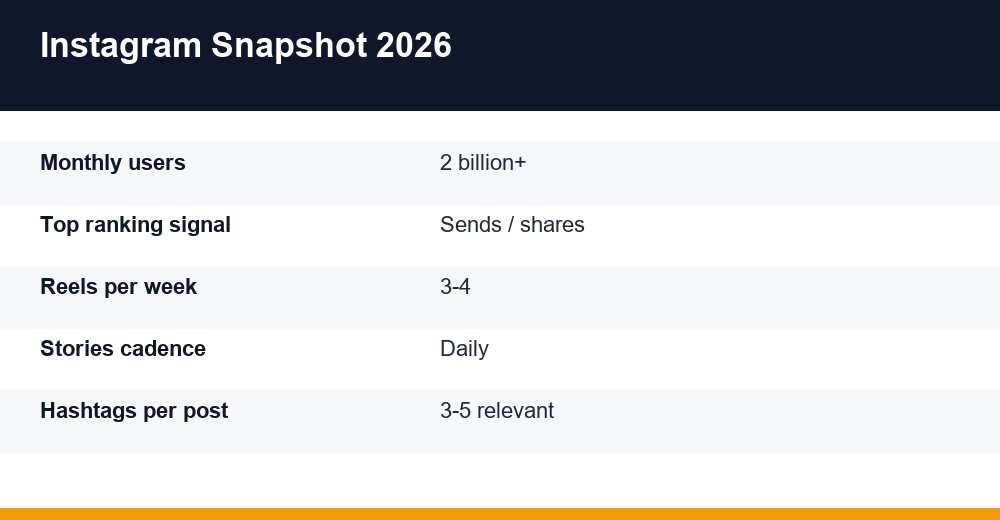
With an estimated two billion people opening the app each month, Instagram is still where visual discovery happens – across fashion, food, fitness, home, beauty and a growing slice of B2B and professional services. That reach is real, but scale alone is never a reason to commit your time to a channel.
So be honest about fit before you invest months of effort. Instagram marketing pays off when what you sell is visual or easy to demonstrate, carries repeat-purchase or high-consideration value, and your buyers actually spend time in the app.
If your customers live on LinkedIn, in Google search or in a trade publication, treat Instagram as a supporting act rather than the headliner. It works best as one pillar inside a wider social media marketing strategy, feeding and being fed by your other channels rather than carrying the load alone.
The channel tends to reward a few kinds of business most clearly:
- Visual and lifestyle brands – food, fashion, beauty, home, fitness and travel – where a single image or clip does much of the selling.
- Local service businesses such as salons, studios, clinics, restaurants and trades that benefit from a nearby, engaged following.
- Personal brands, creators and coaches who sell expertise and trust as much as any physical product.
- Considered purchases where buyers research and compare first, so repeated, helpful exposure pays off over time.
Set expectations early, too. Organic growth here compounds rather than spikes – most accounts need three to six months of consistent publishing before reach and follower quality settle. If you need results next week, pair the organic work with a modest paid budget instead of waiting on a single viral Reel.
Optimize Your Profile So It Converts
Think of your profile as a landing page, because that is how it behaves. Most of your new reach comes from people who do not follow you yet – they see one Reel, tap your name, and decide within seconds whether to stay. If your profile does not immediately say who you help and what they get, they leave.
Two categories of quick wins carry most of the weight.
- Name and handle: put your category or main search term beside your brand in the name field (for example, ‘Bright Bakery – Custom Cakes’). Instagram search weighs that field heavily, and your handle alone rarely covers it.
- Bio: one line on who you serve, one line on the outcome you deliver, and one clear call to action. Cut the emoji clutter and vague slogans.
- Account type: switch to a professional account to unlock insights, contact buttons, ads and scheduling – it is free and does not throttle your reach.
- Links: Instagram now supports several links in your bio, so point people straight to your shop, booking page and lead magnet without leaning on a third-party hub.
- Pinned posts and Highlights: pin three posts that answer your best-selling questions, and organize Highlights around products, FAQs, reviews and how-to-buy.
One more detail: keep your profile photo, Highlight covers and grid visually consistent so a first-time visitor instantly reads you as a real, active brand. A recognisable look also makes your posts easier to spot as people scroll.
These touches compound. A specific, benefit-led profile lifts the share of new visitors who choose to follow, which quietly improves the reach of everything you publish afterwards.
Get the Content Mix Right: Reels, Carousels and Stories
No single format wins on its own. Each does a distinct job, and the accounts that grow steadily use them together rather than betting everything on Reels.
Picture a funnel: Reels pull in strangers and drive discovery, carousels and single posts build authority and earn saves, and Stories keep the people who already know you engaged day to day. A feed of nothing but Reels can rack up views while rarely building the trust that leads to a sale.
| Format | Best for | Suggested cadence |
|---|---|---|
| Reels | Reach and new followers | 3-4 per week |
| Carousels | Teaching and saves | 2-3 per week |
| Stories | Trust and daily contact | Daily |
| Single image | Announcements, authority | As needed |
| Lives / broadcast | Deep connection | Monthly |
Reels still lead discovery, so give the first three seconds real weight – open with movement, a bold claim or the payoff, not a slow build. Keep clips tight enough to loop, add on-screen captions since many people watch on mute, and always export natively rather than reposting a file that carries another platform’s watermark.
The sustainable way to feed all of this is to work one topic five ways. Record a short talk or demo, cut the sharpest 40 to 60 seconds into a Reel, expand the key points into a teaching carousel, drop the behind-the-scenes into Stories, and leave a tidy summary as a searchable single post. One idea becomes five touchpoints for a fraction of the effort, and it spares you a blank calendar.
Posting Cadence and the 2026 Algorithm
Consistency beats volume. Two strong posts a week that you sustain for a year will outperform a daily sprint that burns you out by month two. Batch your filming and editing, then plan a month ahead with a simple content calendar so you never post filler just to keep a streak alive.
It also helps to know what the algorithm actually rewards, because that has shaped how sharp teams approach Instagram marketing this year. There is no single feed algorithm; Instagram ranks Reels, carousels, posts and Stories on slightly different signals, but the priorities now line up clearly.
- Sends and shares – people sending your post to a friend in a DM – are among the strongest signals the platform has. Make things worth passing along privately.
- Saves come next: reference-worthy carousels, checklists and how-tos earn them.
- Watch time and replays drive Reels – hook viewers in the first few seconds and keep clips tight enough to loop.
- Comments and genuine DM replies show real interest; plain likes now carry the least weight of the group.
Two cautions. Ignore generic ‘best time to post’ charts – your own audience’s active hours in insights matter far more. And avoid content that looks recycled from another app; visible watermarks and off-platform logos tend to get down-ranked, so export and post native every time.
Hashtags Done Right and Instagram Search
Hashtags are not the growth engine they were in 2019. They still help Instagram categorize a post, but they no longer flood you with fresh reach, and packing thirty into every caption looks dated. Treat them as quiet labels, not a strategy.
- Use three to five genuinely relevant tags, mixing one or two broad terms with more specific, lower-competition niche ones.
- Write captions in plain language using the words your audience actually types – Instagram search now indexes caption text, not only tags.
- Add descriptive alt text to your images, which helps both search discoverability and accessibility.
- Avoid banned, spammy or wildly off-topic tags, which can suppress a post’s reach rather than help it.
The bigger shift is that people increasingly use Instagram as a search engine in its own right, much as they once used Google. That makes keyword-rich captions, clear on-screen text and descriptive opening lines far more valuable for long-term discovery than any wall of hashtags.
Think in the terms your buyer would type – ‘gluten-free birthday cake’ rather than a clever pun – and place the most important words near the start of the caption and in your first slide or on-screen title. These small habits keep older posts surfacing in search long after they drop out of the feed.
Engagement, DMs and Collaborations
Reach is rented; relationships are owned. Spend ten to fifteen minutes engaging right before and after you publish – reply to every comment quickly, answer DMs like a person rather than a bot, and leave thoughtful comments on the accounts your audience already follows. That early activity signals to the algorithm that the post is worth showing more widely.
Collaborations are the fastest honest way to reach an audience you have not built yet.
- Use the native Collab feature so one post appears on both accounts’ grids and pools the reach, likes and comments.
- Partner with micro-creators – roughly 10,000 to 50,000 followers – who often deliver higher engagement and friendlier rates than big names.
- Actively invite and repost user-generated content; a real customer’s clip usually converts better than a polished ad.
- Run simple joint giveaways or Story takeovers with non-competing brands that serve the same kind of customer.
Treat your DMs as a sales channel, not just a support inbox. Set up a few saved replies for common questions, use quick reactions to keep conversations moving, and read every ‘is this available?’ as a warm lead rather than a chore. A responsive inbox turns casual interest into orders.
Whatever you do, keep the tone conversational. Communities form around accounts that reply, ask questions and remember people – not around broadcast feeds that never talk back.
Track the Metrics That Actually Matter
Strong Instagram marketing is measured in outcomes, not applause. Open your insights once a week and judge each piece of content by the signals that predict growth and revenue rather than the ones that merely flatter your ego.
Give your attention to these:
- Shares and saves per reach – the clearest evidence that content genuinely resonated.
- Reach split between followers and non-followers, which shows whether you are truly growing or talking to the same room.
- Reels retention and average watch time.
- Profile visits and the follow rate they produce.
- Link taps, DM enquiries and, ultimately, sales you can attribute back to the channel.
It helps to separate the numbers that feel good from the numbers that forecast money. Use this quick contrast as a filter when you review a post:
| Vanity metric | Metric that matters | Why it matters more |
|---|---|---|
| Follower count | Follower growth rate | A trend beats a static, easily inflated total |
| Likes | Shares and saves | Both signal real value and lift distribution |
| Impressions | Reach from non-followers | Shows whether you are reaching new people |
| Reel plays | Average watch time | Retention, not raw plays, drives reach |
| Comment count | DM enquiries and link taps | Intent signals sit closer to revenue |
Native insights cover most of this for free; tools like Meta Business Suite, Buffer or Metricool help if you manage several accounts or want scheduling and reporting in one place. Set a simple monthly benchmark, change one variable at a time, and let the data – not a trending video – decide your next move.
Turn Followers Into Customers
The point of Instagram marketing is not a bigger number under your name; it is a fuller pipeline. Followers who never buy are a cost, not an asset, so build conversion into the content itself rather than treating it as an afterthought.
- Add a clear next step to high-performing posts – ‘comment MENU and I’ll send it over’ turns reach into one-to-one conversations at scale.
- Keep your link destination fast and relevant; send Story viewers straight to the specific product or booking page, never a generic homepage.
- Reply to buying-intent DMs within minutes – speed is often the difference between a lead and a lost sale.
- Use Stories to sell without shouting: polls, countdown stickers, testimonials, quick demos and limited-time codes.
- Move your most serious prospects to email or a booking call, so you are not renting the entire relationship from a platform that can change its rules overnight.
Watch where people drop off, as well. If a Reel earns reach but few profile visits, the hook or topic is the weak link; if visits are high but follows and link taps stay low, the profile or offer needs work. Fix the specific leak rather than simply making more content.
Do these things consistently for a single quarter and you will feel the shift – from posting and hoping to running a channel that reliably brings in customers.
Frequently Asked Questions
How often should I post on Instagram?
Consistency matters more than raw frequency. For most businesses, three to four Reels a week, two or three carousels, and daily Stories is a strong, sustainable rhythm that keeps you discoverable without burning out. Pick a pace you can hold for months, prove you can keep it, then scale up only once it feels genuinely easy.
Do hashtags still work in 2026?
Yes, but only modestly. Hashtags help Instagram categorize your post rather than drive big new reach on their own. Use three to five relevant tags, then put real effort into keyword-rich captions and clear on-screen text, because Instagram search now reads your actual words and increasingly behaves like a discovery engine.
Is a business account better than a personal one?
For almost any brand, yes. A professional account unlocks insights, contact buttons, ads and scheduling, and switching is free. The old belief that business accounts get throttled does not hold up – the account type itself will not penalize your reach, though weak or recycled content certainly can.
What is the most important ranking signal now?
Sends – when someone shares your post with a friend in a DM. Instagram has said this outweighs saves, watch time and especially plain likes. The practical takeaway is simple: create content people feel compelled to pass along privately, and stronger reach usually follows on its own.