Local SEO is how a business shows up when nearby customers search for what it sells: in the Google Map Pack, on Maps, and in the organic results below. Win those spots and you reach people who are ready to call, visit, or buy the same day. This guide covers ten tactics that genuinely move local rankings in 2026, plus a checklist you can work straight down.
Table of Contents
What Local SEO Is and How the Map Pack Works
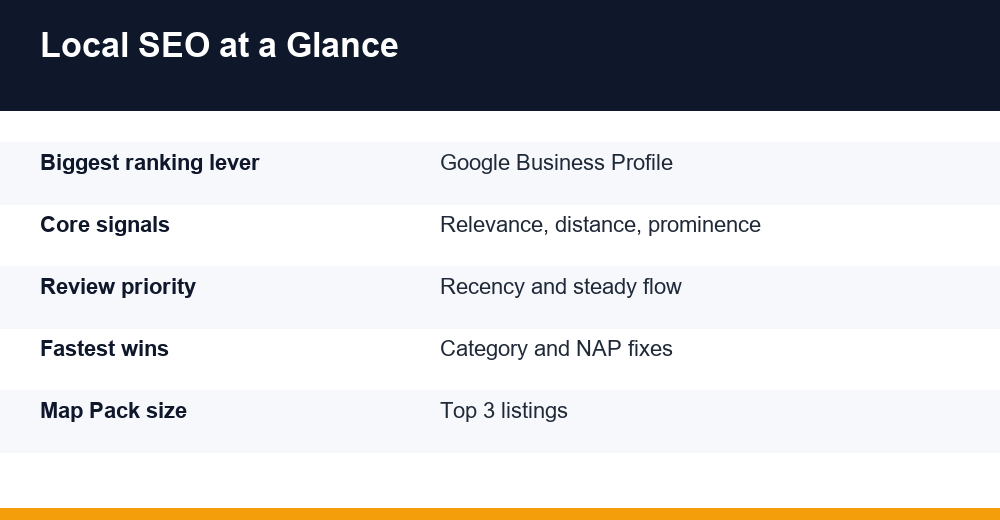
The Map Pack (also called the local pack) is the cluster of three business listings and a small map that sits at the top of most location-based searches. For many queries it answers the question outright: people tap to call, get directions, or read reviews without ever opening a website. That is why those three spots are worth competing for.
Google ranks these results using three signals it states openly: relevance, distance, and prominence. You can read Google’s own local ranking guidance for the source, but the table below turns each pillar into something you can act on.
| Ranking pillar | What it means | How you influence it |
|---|---|---|
| Relevance | How well your business matches the search | Categories, services, description, on-page content |
| Distance | How close you are to the searcher | Verified address, service area, city-level pages |
| Prominence | How known and trusted you are | Reviews, backlinks, citations, brand mentions |
Intent also shapes what a searcher wants. Someone typing “emergency plumber near me” needs a phone number now, while “best Italian restaurant downtown” invites comparison. Matching your profile and pages to that intent, not just the keyword, is what separates listings that earn clicks from listings that get scrolled past.
Strong local SEO works both layers at once: the profile-driven Map Pack and the classic organic listings beneath it. The ten tactics below are ordered roughly by impact and speed, so you can start where it counts most.
Way 1: Optimize Your Google Business Profile
Your Google Business Profile is the single biggest lever you control. In industry surveys such as Whitespark’s annual Local Search Ranking Factors, profile signals are consistently ranked as the most influential factor in the Map Pack. Treat the profile as a living asset, not a listing you fill in once.
Get the fundamentals right
- Primary category: choose the narrowest accurate option (for example, “Personal Injury Attorney” over “Law Firm”), then add relevant secondary categories.
- NAP and hours: keep them exact, current, and complete, including special hours for holidays.
- Description: use the full space to explain what you do and where you serve, in plain language.
- Services and products: list them individually with short, honest descriptions.
- Photos: add real, recent images of your storefront, team, and work, and refresh them regularly.
- Attributes: set the ones that apply, such as “wheelchair accessible” or “women-owned.”
Keep the profile active
- Post updates, offers, or events regularly to lift clicks and engagement.
- Answer the Q&A section, and seed it with the questions customers actually ask.
- Turn on messaging and reply quickly, since profiles that respond slowly can have the feature switched off.
- Add a booking or appointment link where it suits your business.
Posts and photos rarely move pack position on their own, but they drive the clicks and calls that feed Google’s behavioral signals, and those signals matter more every year.
Google increasingly shows justifications under listings, snippets such as “Their website mentions patio seating” or “Reviews mention same-day service.” These are pulled from your profile, site, and reviews, so the words customers and your own pages use directly shape how your listing appears in results.
Ways 2 and 3: NAP Consistency and Local Citations
2. Make your NAP identical everywhere
NAP stands for Name, Address, and Phone number. When these details differ across the web (an old suite number here, a tracking phone number there), search engines lose confidence in which version is correct, and rankings soften. Choose one canonical format and use it everywhere.
Audit your listings, fix conflicts on the highest-authority sources first, and remove duplicate profiles. If you run a service-area business with no storefront, hide your address in the profile and define your service area instead.
3. Build citations that carry weight
A citation is any online mention of your NAP. Quality beats quantity: a handful of authoritative, consistent listings outperform hundreds of spammy directories. Prioritize the tiers below.
| Citation tier | Examples | Why it matters |
|---|---|---|
| Core platforms | Google, Apple Business Connect, Bing Places | Feed maps and AI answers across the ecosystem |
| Major directories | Yelp, Facebook, BBB, Foursquare | High authority and real referral traffic |
| Local and niche | Chamber of commerce, trade bodies, local press | Add local relevance and often a backlink |
Clean up your top 25 sources before chasing volume. Consistent data on trusted sites is one of the strongest compounding signals you can build.
A few data aggregators quietly feed much of the ecosystem. In the United States, platforms such as Data Axle and Foursquare push business data to dozens of downstream sites, so a single error there can reappear across many listings. Fixing the source once often corrects several citations at the same time.
Ways 4 and 5: Reviews and Owner Responses
4. Earn a steady stream of reviews
Reviews are among the strongest prominence signals, and recency and a steady flow matter as much as raw count. A consistent trickle of recent reviews beats a single burst followed by silence.
- Ask every satisfied customer, in person and then with a follow-up text or email.
- Make it one tap by sharing your direct review link.
- Keep the pace steady rather than spiking around a single campaign.
- Never buy reviews or gate them behind a rating filter; both break Google’s policies and risk suspension.
5. Respond to every review
Owner responses can improve your local ranking, and, just as important, they show prospects you are engaged. Reply to positive and negative reviews alike.
- Respond within 24 to 48 hours.
- Thank the reviewer by name and mention the service and city naturally.
- Answer complaints calmly, own the issue, and move the details offline.
Watch for the themes in your reviews, too. When customers repeatedly name a service or neighborhood, that language can surface in Google’s justifications and reassure the next reader. Reviews are market research and a ranking signal at once, so read them, not just count them.
Ways 6 and 7: Local Keywords and On-Page Content
6. Research the terms locals actually search
Local queries look different from generic ones: service-plus-city combinations, “near me” phrasing, and neighborhood names all matter. Ground your list in real search data rather than guesswork. Our keyword research guide walks through finding and prioritizing terms by intent and difficulty.
7. Optimize your pages for local intent
Once you know the terms, place the primary city and service in your title tag, H1, and opening paragraph, without stuffing. Add LocalBusiness schema, keep your NAP in the footer, and make sure the site loads fast on mobile.
- A title tag and H1 that name the service and location
- LocalBusiness structured data with your NAP and hours
- An embedded map with clear directions
- Internal links between related service and location pages
Depth wins locally as well. A page that answers the real questions behind a search (pricing ranges, what to expect, how you compare) earns trust from readers and from the AI answer engines that quote well-structured content. Aim to be the most useful result for that city and service, not merely the most optimized.
The Map Pack sits on top of solid organic foundations. For the technical and on-page groundwork beneath it, work through our complete SEO guide.
Way 8: Location and Service Landing Pages
If you serve several cities or offer distinct services, give each one its own page. Done well, these pages rank for dozens of specific searches. Done lazily, as a template with only the city name swapped, Google treats them as thin doorway pages and may ignore them.
Every location or service page should earn its place. Include, at a minimum:
- A unique introduction genuinely about that city or service
- Specific offerings, pricing guidance, and FAQs
- Local proof: reviews, project photos, and named staff
- An embedded map, directions, and a clickable phone number
- One clear call to action above the fold
Link these pages together with care. A simple hub-and-spoke structure, where a main services page links out to each location and each location links back, helps Google understand your footprint and spreads authority. Avoid orphan pages that no menu or body link points to, because search engines rarely rank what they struggle to find.
If you cannot write something distinct and useful for a location, you probably should not publish a page for it yet.
Ways 9 and 10: Local Links, Tracking, and AI Search
9. Earn local links and brand mentions
Links from relevant nearby sites signal prominence and often carry a citation with them. Look close to home:
- Sponsor local events, teams, or charities
- Join the chamber of commerce and industry associations
- Pitch local news outlets and community blogs
- Partner with complementary nearby businesses and suppliers
10. Track rankings and extend beyond Google
National rank checkers can mislead you about local visibility, because position varies block by block. Use geo-specific or geo-grid tracking, and watch the actions that pay the bills: calls, direction requests, and profile views.
Your profile’s performance report shows how people find and act on your listing, from searches and calls to direction requests. Tag the website link with UTM parameters so those visits stand out in your analytics. Measuring actions rather than rankings alone keeps the focus on customers, not vanity positions.
Finally, look past Google. AI assistants and answer engines increasingly surface local recommendations drawn from your profile, reviews, and consistent data across the web. Keeping Apple Business Connect and Bing Places accurate now protects your visibility as those channels grow.
Your Local SEO Checklist and Mistakes to Avoid
Work down this list in priority order. The items near the top tend to move rankings within weeks; the ones lower down compound over months.
| Action | Typical time to impact |
|---|---|
| Fix your primary category | 2 to 3 weeks |
| Correct NAP on top sources | 2 to 4 weeks |
| Complete every profile field | 2 to 4 weeks |
| Build review velocity | 1 to 3 months |
| Clean up your top 25 citations | 1 to 2 months |
| Publish strong location pages | 1 to 3 months |
| Earn local links | 3 to 6 months |
Mistakes that quietly stall your rankings
- Keyword-stuffing your business name, a policy violation that can get the profile removed
- Using a fake address or an unstaffed virtual office
- Buying reviews or filtering out unhappy customers before they post
- Leaving duplicate or abandoned profiles live
- Ignoring negative reviews instead of responding
- Publishing near-identical city pages with no real local content
Get the fundamentals right and keep them fresh, and local SEO becomes a durable advantage, one that keeps compounding while competitors leave their profiles to gather dust.
Frequently Asked Questions
How long does local SEO take to work?
It depends on the fix. Correcting your primary category or NAP details can shift Map Pack position within two to four weeks. Building review velocity, citations, and local links compounds more slowly, usually over one to six months, with competitive markets taking longer.
Do I need a physical address to rank locally?
Not always. Service-area businesses without a storefront can hide their address and define a service region instead. You still need a real, verifiable location that Google can confirm; a virtual office you do not staff breaks the guidelines and risks removal.
How many reviews do I need to rank in the Map Pack?
There is no magic number. What matters most is a steady, recent flow of genuine reviews and consistent owner responses. A profile gaining a few honest reviews every month usually outperforms one with a large but stale, years-old total.
How does local search ranking differ from regular SEO?
Traditional SEO chases organic results across a whole country, while ranking locally adds the Map Pack, Google Business Profile signals, reviews, and location relevance. The two overlap, since strong on-page work helps both, but ranking locally needs its own profile and citation strategy.