Digital marketing agency pricing is hard to compare because many quotes bundle strategy, labor, software and media into one number you can’t check. This guide breaks the costs down by pricing model and by service, shows where your ad budget ends and the agency’s fee begins, and lists the warning signs that a proposal is padded or vague. All figures are approximate US market ranges for 2026, meant for sanity-checking a quote rather than as fixed prices.
Table of Contents
How Digital Marketing Agency Pricing Works
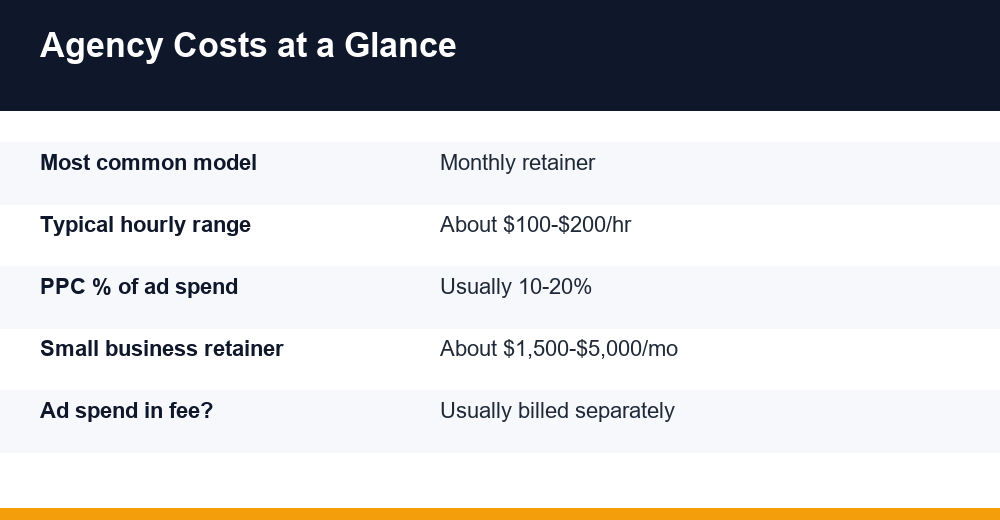
Almost every agency uses some mix of four models. Once you know which one sits under a proposal, you can see what you’re paying for: access to a team, a finished deliverable, time, or results.
Monthly retainer
A retainer is a fixed monthly fee for an agreed scope, for example ongoing SEO, two paid channels and a monthly report. It is the most widely used model because agencies get predictable revenue and clients get continuity. The trade-off is that a retainer pays for capacity, so a loose scope can mean paying the same amount whether the team does a lot or very little.
Project-based fees
Project pricing covers one deliverable with a clear end: a technical SEO audit, a website rebuild, a campaign launch or a brand refresh. It suits businesses that need a specific job done and plan to run things themselves afterwards. Expect a deposit (often 30 to 50 percent) and the rest on milestones or delivery.
Hourly billing
Hourly rates are common for consulting, audits and small fixes. US rates run from roughly $50 an hour for junior freelancers to $300 or more for senior strategists, and most established agencies land somewhere around $100 to $200. Hourly billing is transparent per task, but costs are hard to predict unless there’s a monthly cap.
Percentage of ad spend and performance fees
Paid media is often billed as a percentage of ad spend, usually about 10 to 20 percent, with a monthly minimum. Some agencies offer performance pricing tied to leads or revenue. That sounds attractive, but it only works when tracking is airtight and both sides agree on what counts as a conversion.
| Model | Best for | Main risk |
|---|---|---|
| Monthly retainer | Ongoing SEO, social, multi-channel work | Paying for capacity that isn’t used |
| Project fee | Audits, launches, website builds | Scope creep billed as extras |
| Hourly | Consulting, small fixes, training | Unpredictable monthly totals |
| % of ad spend | Google, Meta, LinkedIn ad management | Incentive to raise spend, not results |
| Performance-based | Lead gen with clean tracking | Disputes over attribution |
Many agencies combine models. A common setup is a flat retainer for strategy and reporting plus a percentage fee on media above a set threshold. Neither is wrong. What matters is that the proposal spells out the combination.
What an Agency Costs per Month
Ask ten agencies what they charge per month and you’ll get ten different answers, because the honest answer depends on scope, channels and seniority. Even so, digital marketing agency pricing tends to cluster around a few recognizable tiers. Treat the ranges below as approximate management fees only. They exclude ad spend.
| Business stage | Typical scope | Approx. monthly fee |
|---|---|---|
| Local or solo business | 1 channel, e.g. local SEO or Google Ads | $750 – $2,500 |
| Small business | 2-3 channels, basic content, monthly reporting | $1,500 – $5,000 |
| Growing SME | Multi-channel, content production, CRO | $5,000 – $15,000 |
| Mid-market / scale-up | Full-funnel team, dedicated strategist | $15,000 – $40,000+ |
What is a typical retainer for a small business?
For most small businesses, a realistic retainer falls somewhere between about $1,500 and $5,000 a month. At the lower end you usually get one channel managed well, such as local SEO with Google Business Profile work or a single paid search account. Toward $5,000 you can expect two or three channels, a content calendar and a strategist who joins monthly calls.
Retainers under about $750 a month deserve a hard look. At typical agency rates that buys only a handful of hours, which is enough for maintenance and reporting but not for strategy, testing or new content. The price isn’t the problem. The problem is when the proposal promises more work than those hours can cover.
Why quotes for the same work vary so much
- Seniority: a senior strategist doing the work costs more than a junior executing a template.
- Location: agencies in major metro areas tend to charge more than regional or offshore teams.
- Content production: original articles, video and design are labor-heavy and push fees up fast.
- Tooling: SEO suites, call tracking and reporting dashboards are often passed through or built into the fee.
- Industry: legal, finance and healthcare work needs compliance review and costs more.
Costs by Service: SEO, PPC, Social and Email
Breaking digital marketing agency pricing down by channel is the clearest way to compare proposals. If an agency offers a bundle, ask it to split the fee by service so you can benchmark each line.
| Service | Common model | Approx. 2026 range (fee only) |
|---|---|---|
| Local SEO | Retainer | $750 – $3,000/mo |
| National / ecommerce SEO | Retainer | $2,500 – $10,000+/mo |
| PPC management | Flat fee or % of spend | $1,000 – $2,500/mo small accounts; 10-20% of spend |
| Social media management | Retainer | $1,000 – $5,000/mo |
| Email marketing | Retainer or per campaign | $500 – $3,000/mo |
| SEO or ads audit | Project | $1,000 – $7,500 one-off |
How much does SEO cost per month?
Small and local businesses usually pay about $750 to $3,000 a month for agency SEO. National brands and ecommerce sites with thousands of pages often pay $2,500 to $10,000 or more. The spread comes from how much content and link earning is included. Technical fixes and reporting are relatively cheap; producing pages that deserve to rank is not.
SEO is also slow. Most reputable agencies tell clients to expect several months before meaningful movement, so budget for at least six months before judging results. If you want to know what good SEO work actually involves before you sign, our complete SEO guide for 2026 walks through the technical, content and authority pieces an agency should be covering.
PPC and paid social management
Paid search management is commonly a flat $1,000 to $2,500 a month for smaller accounts, or a percentage of spend for larger ones. Most agencies set a monthly minimum, so a 15 percent fee on a $3,000 budget may be quoted as a $1,000 floor instead of $450. Setup fees for new accounts, tracking and landing pages are common and should be listed separately.
B2B paid social has its own math because clicks on some platforms cost far more than on others. If LinkedIn is part of the plan, check our breakdown of LinkedIn ads costs so you can tell whether the proposed media budget is large enough to justify the management fee.
Social media and email
Organic social pricing depends mostly on the number of platforms and posts, and on whether the agency shoots original photo or video. Email retainers usually cover campaign design, copy, list segmentation and automation flows. Your email platform subscription is normally billed to you directly rather than through the agency, which is the cleaner arrangement because you keep ownership of your list.
Is Ad Spend Included in Agency Fees?
In most cases, no. Your media budget (the money Google, Meta, LinkedIn or TikTok charges for impressions and clicks) is separate from the agency’s management fee. Your true monthly cost is ad spend plus management fee plus any tools or creative production. A proposal that shows one blended figure should be broken out before you sign.
The cleanest setup is for the ad accounts to sit in your name, with your payment method attached, and the agency granted access as a manager. You then see exactly what the platform charged, and the agency invoices only its fee. When an agency pays the platforms and re-bills you, ask whether there’s a markup on media and get platform invoices or account-level reports every month.
How platform budgets actually behave
Platform spend can fluctuate from day to day, which surprises some clients. Google explains in its help page on average daily budgets that a campaign can spend up to twice its average daily budget on a busy day, while the monthly charge is capped at about 30.4 times the daily average. A $50 daily budget therefore means a ceiling of roughly $1,520 a month, not exactly $50 every day.
Knowing this helps you read agency reports. A spike in one day’s spend isn’t necessarily a mistake, but monthly totals above the expected cap would be worth asking about.
| Cost line | Who receives it | Example (monthly) |
|---|---|---|
| Ad spend | Google, Meta, LinkedIn, etc. | $5,000 |
| Management fee | Agency | $1,000 (20%) or flat $1,500 |
| Creative / landing pages | Agency or freelancer | $500 – $2,000 |
| Tools and tracking | Software vendors | $100 – $500 |
| Total budget | – | About $6,600 – $9,000 |
Agency vs In-House Marketer: Which Is Cheaper?
On paper, one hire can look cheaper than an agency. The US Bureau of Labor Statistics put the median annual wage for market research analysts and marketing specialists at $76,950 in May 2024. Add payroll taxes, benefits, software licences, training and management time, and the real annual cost of a single mid-level marketer often comes to about $95,000 to $115,000. That’s an approximate range and depends heavily on location and benefits.
An agency retainer of $4,000 to $8,000 a month costs roughly $48,000 to $96,000 a year and gives you several specialists, such as an SEO lead, a paid media buyer and a designer, plus the tools they already pay for. A single in-house generalist rarely covers all of that at expert level.
| Factor | In-house marketer | Agency retainer |
|---|---|---|
| Approx. annual cost | $95k-$115k fully loaded | $18k-$96k for SMB scopes |
| Range of skills | One person, generalist | Several specialists |
| Brand knowledge | Deep and immediate | Builds over months |
| Tools included | Paid separately | Often included |
| Flexibility | Hiring and notice periods | Scale scope up or down |
In-house wins when marketing is core to daily operations, needs constant internal coordination or demands deep product knowledge. An agency usually wins when you need specialist skills across several channels at less than full-time volume. Many growing companies end up with a hybrid: one in-house marketing lead who owns strategy and manages an agency for execution.
Automation also changes the math. A capable in-house marketer with the right stack can now cover reporting, drafting and basic optimization that once needed extra headcount. Our roundup of AI marketing tools shows which tasks can realistically be handled in-house and which still benefit from specialist judgment.
Red Flags in Digital Marketing Agency Pricing Quotes
Most agencies price fairly. The problems usually come from vague wording rather than high numbers. Watch for these warning signs in any proposal:
- Guaranteed rankings or results. No agency controls Google’s rankings or platform auctions. A promise of a top spot or a fixed number of leads is a sales line, not a deliverable.
- No itemized scope. “Full SEO package” or “social media management” with no list of tasks, hours or outputs leaves you nothing to hold the agency to.
- Ad spend blended into the fee. If you can’t see what went to the platform and what went to the agency, you can’t measure efficiency.
- Ad accounts in the agency’s name. You should own your Google Ads, Meta, analytics and Search Console properties. Leaving the agency shouldn’t mean losing your data.
- Long lock-ins with no exit clause. Six to twelve months is common for SEO, but there should be a notice period and clear termination terms.
- Unexplained setup fees. Setup is legitimate when it covers real work such as tracking, audits and account builds. It should be itemized.
- Hidden tool or reporting charges. Ask whether software, call tracking and dashboards are included or billed on top.
- Prices far below market. A $299-a-month SEO plan usually means automated reports, low-quality links or mass-produced content that can do more harm than good.
Honest digital marketing agency pricing should also come with clear reporting: which metrics you’ll see, how often, and how they tie back to revenue or leads. If an agency resists defining success up front, it will be hard to judge later whether the fee was worth it.
How to Compare Quotes and Set a Budget
Comparing proposals side by side only works when they describe the same job. Use this process to turn three different quotes into a fair comparison:
- Write a short brief first. List your goals, channels, current ad spend, target audience and what you already do in-house.
- Ask every agency to split its fee by service, separate from media spend, tools and one-off setup work.
- Ask for estimated hours or deliverables per month, such as number of articles, campaigns, ad tests or reports.
- Confirm ownership of ad accounts, analytics, content and creative files in writing.
- Check the contract terms: minimum length, notice period, fee changes and what happens to work in progress.
- Request references or case studies from businesses of a similar size and sector.
- Total the real monthly cost (fee plus ad spend plus tools) and compare it with the revenue a realistic result would bring.
A simple budgeting rule of thumb
For paid channels, the management fee should be small relative to the media it controls. If the fee is close to or larger than the ad budget, the campaign is probably too small to benefit from an agency, and a freelancer or a well-run in-house setup may give a better return. For SEO and content, plan for at least six months of steady spend before judging performance.
Above all, transparent digital marketing agency pricing is a sign of a partner worth hiring. Agencies that itemize their work, keep your accounts in your name and report against agreed goals tend to be easier to trust. The cheapest quote is rarely the best value, and the most expensive isn’t automatically the most skilled.
Frequently Asked Questions
How much does a digital marketing agency cost per month?
Most small and mid-sized businesses pay roughly $1,500 to $15,000 a month in management fees, depending on how many channels are covered and how much content is produced. Single-channel local work can start around $750, while full-funnel programs for larger companies often exceed $15,000. These figures exclude ad spend, which is billed separately by the platforms.
Is ad spend included in agency fees?
Usually not. The agency’s management fee pays for strategy, setup, optimization and reporting, while ad spend goes directly to platforms such as Google, Meta or LinkedIn. The best practice is for ad accounts to be in your name with your payment method, so you can see exactly what the platform charged and what the agency billed.
How much does SEO cost per month?
Local and small-business SEO typically costs about $750 to $3,000 a month with an agency. National, ecommerce or highly competitive campaigns often run $2,500 to $10,000 or more. The main cost driver is how much content creation and authority-building is included, and most campaigns need at least six months to show meaningful results.
Is it cheaper to hire an agency or an in-house marketer?
For many small businesses an agency is cheaper. US market research analysts and marketing specialists earned a median of $76,950 in May 2024 before benefits, taxes and tools, while a small-business retainer often costs $18,000 to $60,000 a year and includes several specialists. In-house makes more sense once marketing needs daily, full-time attention.