LinkedIn ads cost more per click than almost any other major social platform, and many third-party benchmarks put US B2B clicks somewhere between $5 and $12. Those numbers alone don’t tell you much, because published figures contradict each other and a cheap click can still be a bad deal. This guide explains where the benchmarks come from, why they disagree, and how to work out the CPC your own deal size can actually support.
Table of Contents
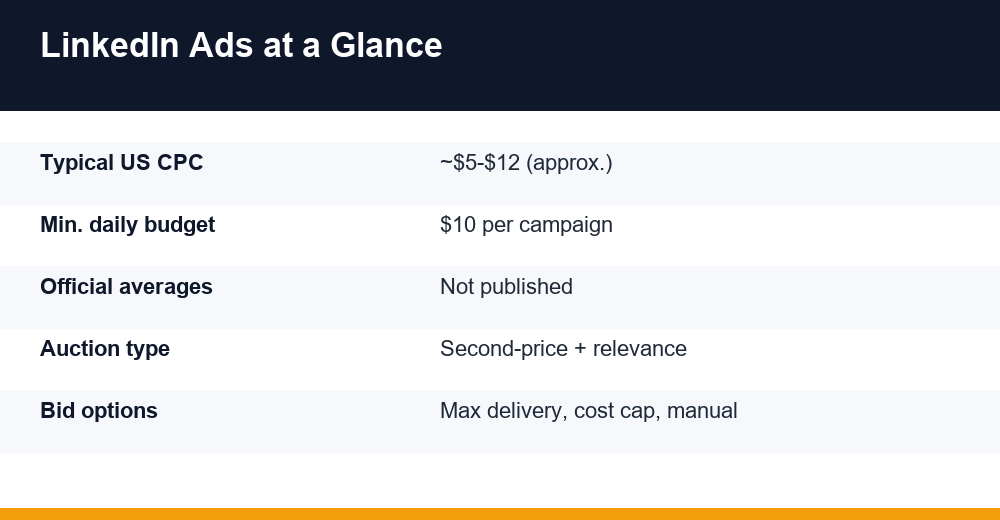
LinkedIn Ads Cost in 2026: The Short Answer
If you need one planning number, use roughly $5 to $12 per click for US-targeted B2B campaigns. That’s where many third-party benchmark reports land. Some report lower averages for broad audiences, and others report $15 or more for competitive industries such as software, finance and legal services.
Clicks are only one way to buy. LinkedIn can charge by click (CPC), by thousand impressions (CPM), by video view (CPV) or by message send, depending on the objective and bidding strategy. So the real LinkedIn ads cost for your account depends on format and bid type as much as on the audience.
Here are the approximate reference points worth knowing:
- CPC: roughly $5-$12 in the US. Audiences in lower-cost markets such as India or parts of Southeast Asia are usually noticeably cheaper.
- CPM: often reported in the tens of dollars for B2B audiences, well above typical consumer social platforms.
- Cost per lead: varies more than any other metric. Agency reports commonly place B2B leads in the low hundreds of dollars, but the definition of a lead changes the number dramatically.
- Message ads: billed per send rather than per click, so compare them on cost per reply or meeting, not CPC.
All of these are estimates. They come from agency and vendor datasets, not from LinkedIn, which doesn’t publish average prices. The only number that matters is what your own Campaign Manager shows after a fair test. For the platform’s own explanation of bidding and budgets, see LinkedIn’s advertising pricing page.
Why Published Benchmarks Disagree
Search for the average LinkedIn ads cost and you’ll find figures ranging from about $2 to $15 per click. Usually nobody is lying. Each benchmark measures a different slice of the platform.
Sample and geography
A report built from US enterprise SaaS accounts will look nothing like one built from small agencies in Europe or Asia. Geography alone can shift CPC a lot. Some datasets are reported in euros, others in dollars, and many blend regions without saying so.
Format and bidding mix
A benchmark dominated by Maximum Delivery campaigns is calculating an effective CPC from impression charges. Manual CPC campaigns, by contrast, are billed per click. Blending Sponsored Content, video and Text Ads into one average hides differences of several dollars per click.
Time window and measurement
Costs move. Several vendor reports have shown LinkedIn CPC creeping up year over year as more B2B budget shifts to the platform, so a guide still quoting 2022 data will likely understate current prices. Cost-per-lead studies also define a lead differently. A Lead Gen Form submission and a demo request on a landing page are not the same thing.
| Why figures differ | Effect on the reported number |
|---|---|
| US vs global audience | US figures usually run higher |
| Enterprise vs SMB sample | Enterprise samples skew CPC upward |
| CPM-billed vs CPC-billed | Effective CPC can swing either way |
| Lead definition | Form fills look cheaper than demo requests |
| Data year | Older reports tend to understate costs |
When you read a benchmark, look for four things: sample size, region, date range and how a lead was defined. If any of them is missing, treat the figure as a rough signal rather than a target.
How Much Do LinkedIn Ads Cost per Click by Format?
Format choice changes both what you pay and what you’re paying for. The notes below are approximate patterns drawn from third-party benchmarks and agency experience for US B2B audiences, not official LinkedIn prices.
| Format | Typical billing | Relative cost pattern | Best use |
|---|---|---|---|
| Single image Sponsored Content | CPC or CPM | Baseline, ~$5-$12 per click | Core prospecting and lead gen |
| Document ads | CPC, CPM or per lead | Often low cost per lead | Gated reports and guides |
| Video ads | CPV or CPM | Cheap views, pricier clicks | Awareness and retargeting pools |
| Message / Conversation ads | Per send | Judge on cost per reply | Event invites and demo offers |
| Text Ads | CPC or CPM | Lowest raw CPC, low CTR | Cheap desktop traffic tests |
| Thought Leader ads | CPC or CPM | Often below brand image CPC | Founder and expert content |
Which LinkedIn ad format is cheapest?
It depends on what you’re counting. On raw CPC, Text Ads, where they’re still available in your account, usually come out cheapest, but they get little attention and low click-through rates. Per lead, the picture changes. Formats that keep people on LinkedIn, such as Document Ads and Lead Gen Forms, generally produce cheaper leads than campaigns that send traffic to an external landing page.
In practice, keep the user on LinkedIn whenever you can. Native forms and document gating remove a page load and a form that’s painful to fill in on mobile, so they usually lower the cost of every lead even when the CPC looks the same. The trade-off is lead quality: pre-filled forms are easy to submit, so check how many of those leads actually reach a sales conversation.
Why Are LinkedIn Ads So Expensive?
LinkedIn’s prices are high because of who it reaches and how few of them there are. You can target by job title, seniority, company size, industry and named account lists, which no other self-serve platform matches at this scale. Advertisers selling five- and six-figure contracts all compete for the same narrow pool of decision-makers.
- Auction pressure: LinkedIn describes its auction as second-price, adjusted for relevance. Many bidders with large deal values push the clearing price up.
- Small audiences: a list of 40,000 IT directors is tiny next to consumer audiences on Meta, so every impression is in demand.
- Lower engagement: people check LinkedIn less often and spend less time scrolling than on consumer apps. With fewer impressions available, each one costs more.
- Relevance weighting: the auction weighs your bid against predicted engagement. Weak creative means you pay more for the same delivery.
For context, B2C platforms often deliver clicks for a dollar or two. If you’re deciding where to put a limited budget, our comparison of Google Ads vs Facebook Ads shows how intent-based search and interest-based social differ on cost per click and cost per lead. LinkedIn usually sits above both on price and above both on targeting precision.
The fair comparison isn’t cost per click. It’s cost per qualified opportunity. A $10 click from a verified VP of Finance can be cheaper per pipeline dollar than a $1 click from someone who will never buy.
What Is the Minimum Budget for LinkedIn Ads?
LinkedIn sets a minimum daily budget of $10 per campaign (or the local-currency equivalent). Campaigns using a lifetime budget also have a minimum, which Campaign Manager shows when you set one up. Check the current figure there, because LinkedIn adjusts these rules from time to time.
There’s also a floor at the bid level. When you choose manual bidding or a cost cap, Campaign Manager shows a suggested range and won’t accept bids below the minimum for that audience. If the minimum bid for a narrow audience is high, the budget you actually need goes up with it.
Minimum vs. useful budget
Running at $10 a day is technically possible, but at $8 per click that buys about one click a day. That’s too little data to judge creative or audiences within a month. A more practical test budget comes from the clicks you need:
- Decide how many conversions make a meaningful test. Around 15-30 leads per campaign is a reasonable floor.
- Divide by your expected click-to-lead rate. At 5%, 20 leads need roughly 400 clicks.
- Multiply by your expected CPC. At $8, that’s about $3,200.
- Spread it over 30 days. That works out to roughly $105 a day for one campaign.
If that number is out of reach, narrow the test to one audience and one offer rather than spreading a small budget thin across many. A focused test that reaches a verdict is worth more than three that never collect enough data.
A Break-Even Calculation Based on Deal Size
Raw CPC can’t tell you whether LinkedIn ads cost too much for your business. What decides it is how much you can afford to pay for a customer, worked backwards to a click. The calculation has four steps:
- Gross profit per customer = customer lifetime value x gross margin.
- Allowable acquisition cost (CAC) = gross profit / target LTV:CAC ratio (3:1 is a common SaaS rule of thumb).
- Maximum cost per lead = allowable CAC x lead-to-customer rate.
- Maximum CPC = maximum cost per lead x click-to-lead conversion rate.
Here are three illustrative scenarios. The inputs are examples, not benchmarks, so replace them with your own CRM data.
| Input / output | Small SaaS | Mid-market SaaS | Enterprise services |
|---|---|---|---|
| Annual contract value | $3,000 | $12,000 | $50,000 |
| Lifetime value | $3,000 (1 yr) | $36,000 (3 yrs) | $150,000 (3 yrs) |
| Gross margin | 80% | 75% | 70% |
| Allowable CAC at 3:1 | $800 | $9,000 | $35,000 |
| Lead-to-customer rate | 2% | 3% | 1.5% |
| Max cost per lead | $16 | $270 | $525 |
| Click-to-lead rate | 5% | 5% | 4% |
| Break-even CPC | $0.80 | $13.50 | $21.00 |
The table makes the point. For the small SaaS product, LinkedIn can’t work on cold prospecting. A break-even CPC of $0.80 is far below any realistic auction price. For the mid-market and enterprise scenarios, a $10 click is comfortably profitable, even though it looks expensive.
If your numbers resemble the first column, put your prospecting budget where intent is cheaper. Google’s automated Performance Max campaigns are one option. Keep LinkedIn for small, high-value account lists or retargeting.
Two refinements make the model more honest. First, measure lead-to-customer rate by channel, because LinkedIn leads often close at a different rate from search leads. Second, B2B buying cycles can run for many months, so allow for a lag before judging ROI on closed revenue.
7 Ways to Cut Your LinkedIn CPC
Once you know your break-even, the goal is to widen the gap between it and what you pay. These are the levers that most reliably bring LinkedIn CPC down without starving delivery.
- Improve click-through rate first. The auction weighs predicted engagement alongside your bid, so stronger creative wins impressions at lower prices. Test hooks, specific numbers and plain-language headlines before you raise bids.
- Match the bid strategy to your goal. Maximum Delivery spends the budget fully and is usually billed by impression. A cost cap aims to keep results near your target. Manual bidding gives the most control but needs frequent monitoring.
- Start manual bids at the low-to-mid suggested range, then adjust. If delivery stalls, raise in small steps instead of accepting the top of the range by default.
- Avoid tiny audiences. Very narrow targeting tends to raise the minimum bid. Layer job function with seniority instead of stacking exact titles, and check the forecasted audience size before launch.
- Turn off Audience Expansion and the LinkedIn Audience Network when testing. Both can lower apparent CPC while sending you weaker traffic, which muddies your break-even maths.
- Use Thought Leader ads and document ads. Posts from a real person and gated documents often get higher engagement than polished brand creative, which tends to lower effective CPC.
- Retarget warm audiences. Video viewers, company page visitors and website retargeting pools usually convert better, so the same CPC buys more pipeline.
Make one change at a time and give each change enough budget to collect data. Changing creative, bids and targeting all at once makes it impossible to see what actually worked.
Are LinkedIn Ads Worth It for B2B?
For most B2B companies with a meaningful contract value, yes, as long as you judge the channel on pipeline rather than clicks. Attribution vendors and agencies regularly rank LinkedIn among the strongest B2B paid channels for influenced pipeline, which is why demand and prices stay high. Treat any single vendor’s return figures with caution, since they reflect that vendor’s own client base.
LinkedIn is a weaker fit in these cases:
- Your break-even CPC is below about $3, which is common for low-priced self-serve products.
- Your buyers can’t be identified by job title, company or industry.
- You can’t keep a test running for at least a month at a realistic budget.
- You have no way to track leads through to opportunities and revenue.
Many teams get the best results by combining platforms. They use LinkedIn to reach precise accounts, then retarget those visitors more cheaply on Meta. Our Facebook Ads guide covers how to build those retargeting audiences. In that setup, the higher LinkedIn ads cost is spent only where its targeting adds value, and cheaper channels do the follow-up.
Set a break-even CPC before you launch and measure cost per opportunity rather than cost per click. Review it monthly against closed revenue.
Frequently Asked Questions
How much do LinkedIn ads cost per click?
Many third-party benchmarks place US B2B clicks between roughly $5 and $12, with competitive sectors such as software and finance often higher. Campaigns targeting lower-cost markets are usually cheaper. LinkedIn does not publish official averages, so treat these figures as approximate and confirm them against your own Campaign Manager data after a fair test.
What is the minimum budget for LinkedIn ads?
LinkedIn requires at least $10 per day per campaign, and lifetime budgets have their own minimum shown in Campaign Manager. Narrow audiences can also carry a high minimum bid. In practice, a useful test usually needs far more, often a few thousand dollars per month for one campaign, to generate enough leads to judge results.
Which LinkedIn ad format is cheapest?
On raw cost per click, Text Ads are usually cheapest where still available, but they have low visibility and click-through rates. Per lead, native options tend to win. Document Ads and Lead Gen Forms keep people on LinkedIn and generally produce cheaper leads than campaigns that send traffic to an external landing page.
Are LinkedIn ads worth it for B2B?
They are usually worth it when your customer lifetime value supports a break-even CPC above typical auction prices, which is often the case for contracts in the mid-thousands of dollars or more. They rarely pay off for low-priced products. Judge results on cost per qualified opportunity and closed revenue, not on cost per click.