Generative engine optimization is the practice of making your content easy for AI systems like Google AI Overviews, AI Mode, ChatGPT and Perplexity to find, trust and cite in their answers. Much of what gets sold under the GEO label is either rebranded SEO or untested folklore. This guide separates what the platforms actually document from vendor hype, then gives you a content structure, a set of off-site tactics and a measurement workflow you can run this quarter.
Table of Contents
What Is Generative Engine Optimization?
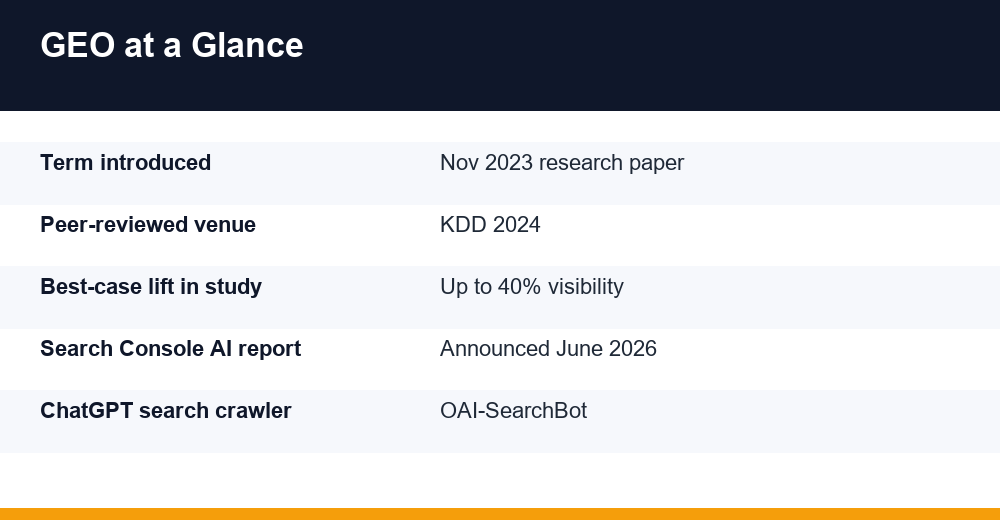
The term comes from a research paper titled GEO: Generative Engine Optimization, posted to arXiv in November 2023 by researchers from Princeton, Georgia Tech, the Allen Institute for AI and IIT Delhi, and later presented at KDD 2024 in Barcelona. The authors defined a generative engine as a system that retrieves sources and then writes a synthesized answer, rather than returning a ranked list of links.
In that model, “ranking” changes meaning. Your page is not competing for position three on a results page. It is competing to be one of the handful of sources the model reads, quotes or links beside its answer. Visibility is measured by how much of the answer is attributable to you and how prominently your citation appears.
The paper introduced a benchmark called GEO-bench, roughly 10,000 queries across many domains, and tested a series of content edits against it. Its headline finding was that some methods boosted source visibility by up to 40%. That is a best-case figure: the authors themselves stressed that results varied by domain.
The methods that performed best were adding citations to credible sources, adding relevant quotations and adding statistics. Simple keyword stuffing did not help. Fluency and readability edits gave smaller but consistent gains.
Treat that research as a useful direction, not a guarantee. It was run on a lab setup plus Perplexity, and commercial engines have changed their retrieval systems many times since 2023. Any vendor quoting the 40% figure as a promise is misreading the paper.
How GEO Differs From SEO (and Where It Doesn’t)
The honest answer is that GEO overlaps with SEO far more than most agency pitch decks admit. AI Overviews and AI Mode draw on Google’s index. ChatGPT search relies on OpenAI’s own crawler plus third-party search providers. If a page cannot be crawled, indexed and understood, no amount of “AI optimization” will get it cited.
Google itself frames it this way: from its perspective, optimizing for generative AI search is still SEO. Where the disciplines genuinely diverge is in the unit of competition and in how success is measured. If you need a refresher on the foundations, our complete SEO guide for 2026 covers the ranking basics that GEO builds on.
| Dimension | Traditional SEO | GEO / AI search |
|---|---|---|
| Unit of competition | Whole page vs. other pages | Passages and facts inside pages |
| Primary outcome | Ranked blue link, click | Citation or mention inside an answer |
| Query shape | Short keywords, some questions | Longer conversational prompts, follow-ups |
| Key signals | Relevance, links, page experience | Same base, plus clarity, sourcing, brand corroboration |
| Measurement | Rankings, clicks, CTR | Impressions in AI features, citation share, referrals |
| Index source | Search engine index | Search index plus engine-specific crawlers |
The practical takeaway: do not split your team into an “SEO squad” and a “GEO squad”. Run one content program, then add the AI-specific layers covered below: answer-first structure, verifiable claims, off-site corroboration and new measurement.
What Google Officially Says About AI Features
Google has published direct guidance on this, and it contradicts a lot of what is sold as generative engine optimization. Its Search Central page on AI features and your website states that to appear as a supporting link in AI Overviews or AI Mode, a page must be indexed and eligible to show in Search with a snippet, and that there are no additional technical requirements. It also confirms that standard SEO best practices still apply.
Google expanded on this in a May 2026 guide to optimizing for generative AI features in Search. The main points:
- No special files or markup are needed. Google says you don’t need machine-readable AI files, AI text files or special markup to appear, and llms.txt gets no special treatment in Search.
- Skip artificial chunking. Breaking content into tiny fragments for machines is on Google’s list of tactics site owners can ignore, as is AI-specific rewriting.
- Don’t manufacture mentions. Pursuing inauthentic brand mentions is on the same list.
- Keep basics in order. Allow crawling in robots.txt and at your CDN or host, keep important content in text, and make structured data match visible text.
- Snippet controls still apply. nosnippet, data-nosnippet, max-snippet and noindex limit how your content appears in AI features.
- Google-Extended is separate. It governs use of content for Gemini training and grounding outside Search, not your eligibility for AI Overviews.
Alongside its June 2026 reporting update, Google also announced a Search Console control that lets sites opt out of Search generative AI features, starting with a subset of UK site owners. Sites that opt out get no traffic or impressions from those features. If your visibility drops suddenly, check that nobody switched it on by mistake.
This guidance should be your filter. If a vendor’s core deliverable is an llms.txt file, a “chunked” rewrite of your site or bulk forum posting, you are paying for something Google has said it doesn’t use or actively discourages.
How to Get Your Content Cited in AI Overviews
There is no switch for AI Overview citations, but some content patterns make it much easier for a retrieval system to lift a passage and credit you. These are good editing practice for human readers too, which is why they are safe to adopt.
Start with crawlability and indexing
Every citation begins with a page Google can fetch, render and index with a snippet. Blocked resources, rogue noindex tags, canonical errors and JavaScript-only content quietly remove you from the candidate pool. Work through our technical SEO checklist before touching copy, and use URL Inspection in Search Console to confirm key pages are indexed.
Write answer-first passages
Put the direct answer in the first one or two sentences under each heading, then expand. A section headed “How long does a website migration take?” should open with a range and the main variables, not a history of migrations. This is the passage citability principle: each section should make sense if quoted on its own.
- Use headings that mirror real questions, including the follow-ups people ask next.
- Define terms the first time you use them, in plain language.
- Keep one idea per paragraph so a passage can be quoted cleanly.
- Use tables for comparisons, prices, specs and step sequences.
- Write naturally. Answer-first is an editing habit, not a reason to split pages into fragments.
Make claims verifiable
The original GEO research found that citing sources, quoting experts and adding statistics produced the largest gains. In practice that means naming where a number comes from, dating it and avoiding unsupported superlatives. Original data you collected yourself is the strongest version of this, because nobody else can supply it.
Show first-hand experience
Google’s guidance keeps returning to people-first, original content. Pages that read like a summary of the top ten results add nothing for a model that already has those ten results. Specific case details, step-by-step descriptions of your own process, real costs and real failures are what differentiate a source.
How to Show Up in ChatGPT Search Results
ChatGPT uses separate crawlers for separate jobs, and confusing them is the most common technical mistake we see. OpenAI’s crawler documentation describes three user agents:
| User agent | Purpose | Block it if… |
|---|---|---|
| OAI-SearchBot | Surfaces sites in ChatGPT search answers | You don’t want to appear in ChatGPT search |
| GPTBot | Crawls content that may be used for model training | You want to opt out of training only |
| ChatGPT-User | Fetches pages when a user’s request triggers it | Rarely; not used to decide search inclusion |
OpenAI states that sites opted out of OAI-SearchBot will not be shown in ChatGPT search answers, though they can still appear as navigational links. It also notes that robots.txt changes can take about 24 hours to take effect. Many publishers block GPTBot while allowing OAI-SearchBot, which keeps training and search visibility as separate decisions.
Beyond access, the content advice is the same as for Google: clear answers, verifiable facts and a site that other credible sources talk about. Because ChatGPT also draws on third-party search results, solid organic rankings help, and Bing visibility is worth checking in Bing Webmaster Tools rather than assuming Google coverage is enough.
No one outside OpenAI can promise a “ranking” in ChatGPT. Answers vary by prompt wording, conversation history and location. Aim to be consistently present across a set of prompts rather than chasing one lucky result.
Does Schema Markup Help AI Search Visibility?
Short answer: it helps indirectly, and it is not a shortcut. Google has said AI Overviews and AI Mode need no special markup, and over-investing in structured data for AI purposes is among the myths its May 2026 guide addresses. There is no “AI schema” type that triggers citations.
Structured data still earns its place for three reasons:
- Rich result eligibility. Product, Recipe, Event, Article and other supported types still power enhanced search results that drive clicks.
- Entity clarity. Organization, Person and sameAs properties help tie your brand, authors and social profiles together consistently.
- Data hygiene. Prices, availability and dates in markup must match the visible page, which forces you to keep facts consistent.
What to avoid: marking up content users can’t see, adding FAQ markup to every page, or inventing review markup. Mismatched structured data can make you ineligible for rich results, and it adds nothing a model can’t read from the page itself.
Off-Site Brand Mentions and Entity Signals
AI answers about “best project management tools for agencies” or “top accountants in Leeds” are rarely built from one page. They synthesize what many sources say. Google’s own guide acknowledges that AI features can reflect what is said about products and services across blogs, videos and forums.
If your brand is only described on your own website, you have one vote. If independent reviewers, trade publications and comparison articles describe you consistently, you have many. This is where generative engine optimization overlaps with digital PR, and where it is easiest to cross ethical lines.
Google lists inauthentic mentions as a tactic to ignore, and the FTC requires paid endorsements and reviews to be clearly disclosed. Earn coverage; don’t fabricate it.
- Publish citable assets: original surveys, benchmarks or pricing studies that journalists and bloggers will reference.
- Pitch expert commentary to trade media on topics where you have genuine data or experience.
- Keep listings consistent: your business name, category and description should match across Google Business Profile, LinkedIn, directories and review sites.
- Get into honest comparisons: provide accurate specs and pricing to editors who write roundups in your category.
- Answer in communities where your customers ask questions, under your real identity, without astroturfing.
Do a quick audit: ask several AI tools to describe your company and list competitors in your category. Wrong or outdated descriptions usually trace back to a stale directory listing, an old press release or a comparison page you can ask the owner to update.
How to Measure Visibility in AI Search Engines
Measurement is where GEO is weakest, so be precise about what each source can and can’t tell you.
Google Search Console
AI Overviews and AI Mode traffic has always been counted in the standard Search Console performance report, just not separated out. In June 2026 Google announced Search generative AI performance reports, one for Search and one for Discover, with rollout starting in the UK before expanding. The Search view shows impressions by page, country, date and device, without clicks or queries, and it does not split AI Overviews from AI Mode.
Analytics referrals
Clicks from ChatGPT, Perplexity, Copilot and Gemini often arrive with an identifiable referrer. Create a channel group in your analytics tool for these domains so AI referrals stop disappearing into “referral” or “direct”. Expect undercounting: some apps strip referrers.
Prompt tracking
Build a fixed panel of 30 to 100 prompts that match real customer questions, run them on a schedule across engines and log whether you are cited, mentioned or absent. Third-party tools automate this, but a spreadsheet works for smaller sites. Keep prompts stable so trends are comparable.
| Signal | Source | What it tells you | Limitation |
|---|---|---|---|
| AI feature impressions | Search Console gen AI report | Which pages appear in Google AI features | No clicks or queries |
| AI referral sessions | Analytics channel group | Traffic and conversions from AI tools | Missing referrers undercount |
| Citation share | Prompt tracking panel | How often you’re cited vs. competitors | Answers vary run to run |
| Brand description accuracy | Manual AI audits | Whether AI describes you correctly | Qualitative, time-consuming |
| Branded search volume | Search Console queries | Indirect demand from AI exposure | Many other influences |
A 90-Day Generative Engine Optimization Workflow
Here is the sequence we use with clients. It favors fixes Google and OpenAI actually document over speculative tactics.
- Weeks 1-2, access audit: confirm indexing, snippet eligibility, robots.txt and CDN rules for Googlebot, Bingbot and OAI-SearchBot, and any Search Console AI settings.
- Weeks 2-3, baseline: set up the AI referral channel, export Search Console AI impressions if available, and run your first prompt panel.
- Weeks 3-6, priority rewrites: take the 10-20 pages tied to revenue and restructure them answer-first, with sourced figures, dated facts and comparison tables.
- Weeks 4-8, clean the library: merge or retire thin, outdated and duplicate posts so your strongest page on each topic is the obvious candidate. Our content pruning guide explains how to decide what to keep.
- Weeks 6-12, off-site corroboration: publish one original data asset, fix inconsistent listings and pitch expert commentary.
- Week 12, review: rerun the prompt panel, compare AI impressions and referrals, and decide which page patterns to roll out sitewide.
Set expectations honestly. Gains in AI visibility are noisy and slower to read than ranking changes, and attribution will stay approximate. The upside is that every step above also strengthens classic organic performance, so the work pays off even if a given AI surface changes next quarter.
Done well, generative engine optimization is not a separate trick. It is disciplined SEO, clearer writing and real reputation building, measured with a few new instruments.
Frequently Asked Questions
What is generative engine optimization?
It is the practice of making content easy for AI answer engines such as Google AI Overviews, AI Mode, ChatGPT and Perplexity to retrieve, trust and cite. The term comes from a 2023 research paper presented at KDD 2024. In practice it combines solid SEO with answer-first writing, verifiable claims and consistent brand mentions across independent sources.
How is GEO different from SEO?
SEO competes for ranked links and clicks, while GEO competes for citations and mentions inside AI-generated answers. The foundations are shared: crawlability, indexing, relevance and quality. GEO adds passage-level clarity, sourced facts, off-site corroboration and new measurement such as AI feature impressions, AI referral traffic and prompt-based citation tracking.
Does schema markup help with AI search visibility?
Not directly. Google says AI Overviews and AI Mode need no special markup and there is no AI-specific schema type. Structured data still helps with rich result eligibility, clarifies your organization and authors as entities, and keeps prices and dates consistent. It must always match the content visible on the page.
How do you measure visibility in AI search engines?
Combine three sources. Use Google Search Console’s generative AI performance report for impressions in AI features, an analytics channel group for referrals from tools like ChatGPT and Perplexity, and a fixed panel of real customer prompts checked on a schedule to log citations versus competitors. Expect approximate rather than exact attribution.