Few growth loops in India have spread as quickly as the refer-and-earn schemes behind colour-prediction apps. For marketers, they are a useful case study in viral mechanics, community channels and influencer reach.
Table of Contents
What the App Is and Why Marketers Notice It
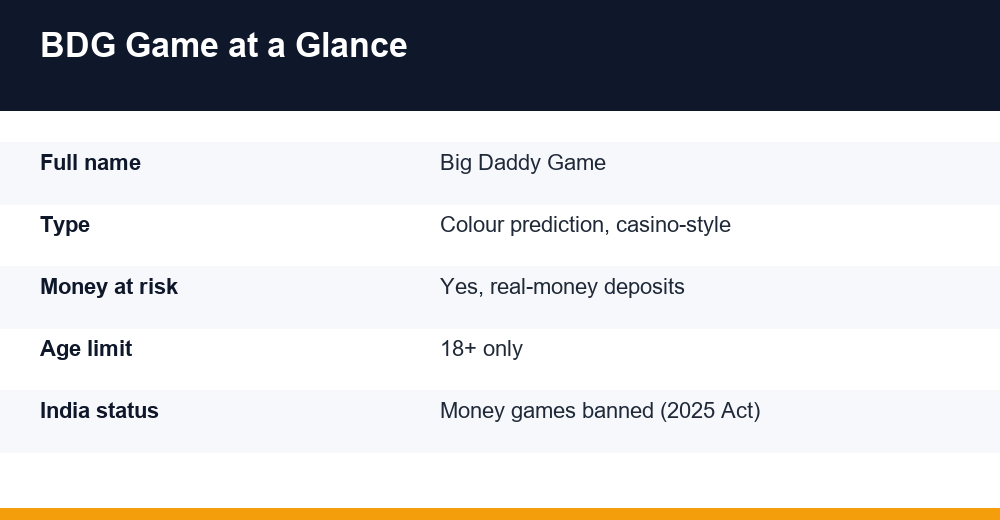
BDG Game, short for Big Daddy Game, is a real-money app aimed at players in India. Its best-known format is colour prediction: users stake money on whether a short timed round will land on a colour or number, and the platform bundles other casino-style games alongside it.
Real money is at risk, outcomes are driven by chance, and the design includes a built-in house edge, which means negative expected value for the player over time. These apps are for adults only (18+), and nothing here is an invitation to sign up or deposit.
So why would a digital marketing blog care? Because apps in this category grew largely without conventional advertising. They relied instead on user-driven acquisition: invite links, commission tiers and chat-group communities. Attached to a money game, those invite mechanics push financial risk onto friends and family who never asked for it.
How the Referral Loop Works
At its core, the scheme looks like most refer-and-earn programmes. An existing user receives a unique invite code or link. When someone registers through it and starts transacting, the referrer earns a reward, usually framed as a commission on the new user’s activity.
What sets colour-prediction apps apart is the multi-tier commission structure. Rewards are described as flowing from people you invite and from the people they invite, several levels down, which resembles network-marketing compensation more than a typical app referral.
- A user joins and is shown an “agent” or “invite” dashboard almost immediately.
- They share their link in personal chats, Telegram channels or WhatsApp groups.
- New sign-ups are tracked to the referrer, often across multiple tiers.
- Commissions are tied to the downline’s play volume, not to one-off sign-ups.
- Rewarded referrers recruit more people, and the cycle repeats.
The critical detail is step four. Because income depends on how much referred people play, the incentive is not just to recruit but to keep recruits playing. That is where a growth tactic becomes an ethical problem.
6 Marketing Lessons from Refer-and-Earn Loops
Strip away the gambling context and the model still demonstrates principles that apply to legitimate products.
1. Put the referral offer inside the product
The invite dashboard is part of the core experience, not hidden in a settings menu. A referral prompt shown at a moment of satisfaction usually outperforms a link buried in a footer.
2. Make sharing frictionless
One tap generates a link formatted for chat apps. Every extra step in a share flow loses people, which is just as true for a SaaS free-month offer or a retail discount code.
3. Show progress in real time
Live counters of invites and earnings create a feedback loop. Visible progress towards a clear, modest reward, such as a free month or early access, is a fair use of the same psychology.
4. Community is the distribution channel
Groups do the heavy lifting. Brands that build owned communities gain reach that paid media cannot easily buy. Our guide to building an email list the right way covers the consent-first version of this idea.
5. Layered rewards amplify reach, and risk
Multi-tier incentives push sharing far beyond a user’s immediate circle. Most brands are better served by a single, generous tier.
6. Trust is the real currency
Referral growth borrows the referrer’s credibility. When the product harms the people being referred, that credibility is spent, for the individual and for any brand associated with the promotion.
| Tactic seen in money-game loops | Ethical equivalent for brands |
|---|---|
| Multi-tier commissions on play volume | Single-tier, fixed reward per qualified sign-up |
| Earnings tied to losses of referrals | Rewards tied to genuine product value |
| Pressure posts in chat groups | Opt-in community with clear rules |
| Undisclosed influencer promos | Clearly labelled paid partnerships |
| “Earn money” framing | Honest benefit and limitation statements |
Telegram, WhatsApp and Influencer Promotion
Much of the promotion around colour-prediction apps happens in Telegram channels and WhatsApp groups. Typical content includes “prediction” signals, screenshots of supposed wins and urgent calls to join through a specific invite code.
Short-form video and social influencers form the second layer. Organic reach on visual platforms is a powerful lever, as our Instagram marketing tips explain, but it carries responsibility for what is being promoted.
“Signal” groups imply that results can be predicted, but in a chance-based game with a house edge no tip service changes the odds. For agencies the point is simple: if a brief asks you to seed invite codes into chat groups or pay creators per sign-up for a real-money game, decline it.
ASCI Disclosure Rules and Red Flags
Before the 2025 Act, the Advertising Standards Council of India (ASCI) already set guardrails. Its influencer guidelines require any post with a material connection to an advertiser, such as payment, free products or commissions, to carry a clear label like #ad, #collab or #sponsored, placed upfront where people see it without clicking “more”.
ASCI’s real-money gaming guidelines also barred targeting minors, presenting gaming as a source of income and omitting a risk disclaimer. If you come across a referral post for one of these apps, a few checks help:
- Is the creator disclosing a commission or payment?
- Does the post promise income or easy wins? That is misleading by design.
- Is there any verifiable company name, address or grievance contact?
- Are withdrawals described as conditional on further deposits or recruitment?
We are not calling any specific platform a fraud. However, if you have lost money to a suspicious app or scheme, report it at the National Cyber Crime Reporting Portal (cybercrime.gov.in) or call the helpline 1930. If gambling is affecting your wellbeing, Tele-MANAS offers free mental-health support on 14416.
Building an Ethical Referral Programme Instead
The useful takeaway is not how to copy this model but how to keep what works and drop what harms. Anyone studying it can see how the app presents itself on its BDG Game registration pages, read the way you would read anything a company writes about its own product.
- Reward value, not volume. Pay a fixed incentive for a qualified customer, not a share of what they spend or lose.
- Keep it to one tier. Multi-level rewards invite spam and resemble pyramid structures.
- Disclose everything. Make referral relationships obvious, in line with ASCI labels.
- Respect consent. Never encourage bulk-forwarding to people who did not opt in.
- Check the category. If the product is a real-money game in India, do not promote it at all.
- Measure quality. Track retention and satisfaction of referred users, not just sign-ups.
Viral loops are powerful because they run on trust between friends. For marketers, that is the clearest lesson colour-prediction apps have to teach.
Frequently Asked Questions
Can you predict colour-game results to earn money?
No. Outcomes are chance-based and the platform has a built-in house edge, so expected value for players is negative. Groups selling prediction signals or guaranteed wins are a red flag. Real money is at risk and these apps are for adults only.