TikTok marketing for small business is no longer a gamble on viral dances: it is a search engine, a local discovery feed and a cheap test bed for ads, all in one app. This playbook is written for plumbers, salons, cafes, clinics, accountants and other local or service businesses that cannot afford a production team. You will get ten tactics, real budget floors and a clear rule for when paid promotion makes sense.
Table of Contents
Is TikTok Marketing for Small Business Worth It in 2026?
Short answer: yes, if your business can show something. TikTok rewards visible work, expertise and personality far more than budget. A dog groomer with a phone can outperform a national chain, because the feed ranks individual videos on how people react to them, not on how big the account is.
The bigger shift is search intent. Many people now type questions straight into TikTok: “best brunch near me”, “how much does a boiler service cost”, “what happens at a first physio appointment”. A video that answers those queries can keep getting found for months, which makes the channel behave more like SEO than like a fleeting social post.
That said, TikTok marketing for small business is not a fit for everyone. It works best when at least one of these is true:
- Your work has a visible before-and-after (cleaning, detailing, renovation, hair, landscaping).
- Customers ask the same questions repeatedly (pricing, process, what to expect).
- There is a personality behind the business that people would enjoy watching.
- You serve a defined area and want locals to recognise your name.
It is a weaker fit if your work happens behind closed doors for confidentiality reasons, if your buyers are a handful of large corporate accounts, or if nobody on the team is willing to appear or speak on camera. Faceless formats such as screen recordings or hands-only footage can work, but they take more planning to stand out.
If none of the positive signals apply, TikTok can still support awareness, but it should sit inside a wider social media marketing strategy rather than carry your lead generation alone.
Should You Use a TikTok Business Account?
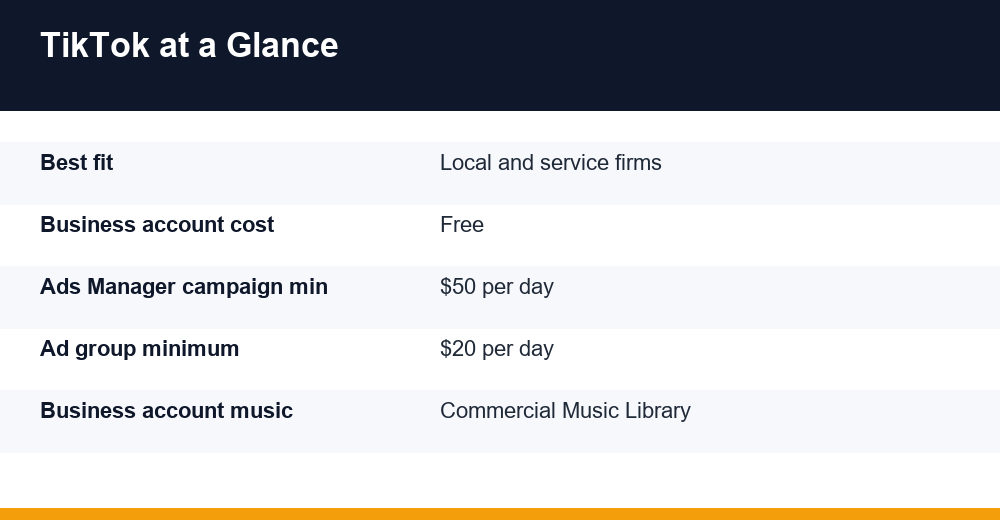
For most companies, yes. A Business account is free and unlocks fuller analytics, a business category on your profile, contact options, and access to tools such as Promote and Ads Manager. Switching is done in the app under account settings, and you can switch back later if it does not suit you.
The main trade-off is music. Business accounts are limited to TikTok’s Commercial Music Library, a catalogue of pre-cleared tracks. Trending songs from the general library are off-limits for brand content, and the commercial-use rule applies to promotional posts even on personal accounts. In practice, original audio such as your voice or the sound of the work itself performs well for service businesses anyway.
| Feature | Personal account | Business account |
|---|---|---|
| Cost | Free | Free |
| Music | Full library (non-commercial use) | Commercial Music Library only |
| Analytics | Basic | Fuller audience and content data |
| Profile contact options | Limited | Business category and contact details |
| Paid promotion | Promote | Promote plus full Ads Manager use |
| LIVE gifts | Available if eligible | Generally not available |
A sole trader who is the face of the brand sometimes keeps a personal account to use LIVE gifts or trending audio. If you sell a service and plan to run any paid promotion, the Business account is the cleaner choice. Feature sets change regularly, so check the current options in your app before you switch.
Tactics 1-3: Win TikTok Search, Not Just the For You Page
Chasing the For You page is unpredictable. Search is far less so. These three tactics build a library of videos that keeps sending enquiries long after you post.
1. Build a question bank before you film
List every question customers ask on calls, in emails and at the counter. Then type the start of each into the TikTok search bar and note the autocomplete suggestions. Those suggestions show the exact phrasing people use. Aim for 30 questions; at three posts a week, that is more than two months of content.
Group the questions into three buckets: cost (“how much does…”), process (“what happens when…”) and comparison (“is X better than Y”). Cost questions tend to attract people closest to buying, so film those first.
2. Say the keyword three ways
TikTok reads more than the caption. Put the target phrase in your spoken audio, in on-screen text in the first seconds, and in the caption. A roofer might say “How much does a roof repair cost in Leeds?” on camera, show the same line as text, and repeat it in the caption with two or three relevant hashtags.
3. Answer first, explain second
Open with the answer or the finished result, then show how you got there. Viewers decide in a second or two whether to keep watching. The same principle drives video search elsewhere; if you also post on YouTube, our guide to YouTube SEO for beginners covers how titles and descriptions work there, and many of the same question-led videos can be reused as Shorts.
This search-first approach is the backbone of TikTok marketing for small business because it does not depend on luck. One clear video answering a costly question can do more for bookings than ten trend-chasing clips.
Tactics 4-5: How Local Businesses Get Customers on TikTok
Local and service businesses do not need a national audience. They need the few thousand people within driving distance to recognise them and remember how to get in touch.
4. Tag locations and name your area
Add a location tag to every post and mention your town or neighbourhood out loud. TikTok has been adding location-based discovery, including a Nearby-style feed in some markets that surfaces posts from places close to the viewer. Availability differs by country and changes often, but clear location signals also help your videos surface for “near me” style searches wherever you operate.
Film recognisable local landmarks, streets or venues when it fits naturally. Viewers who spot a place they know are more likely to stop scrolling, and it reinforces that you actually work in their area.
5. Turn views into a clear next step
Views are worthless if people do not know how to book. Make the path obvious:
- Complete your profile: business category, area served and opening hours in the bio.
- Add contact options or a link to a booking page where your account allows it.
- End videos with one spoken call to action, such as “DM us your postcode for a quote”.
- Pin three videos to your profile: what you do, typical pricing and a customer result.
- Reply to comments with video replies; each one is another searchable answer.
Ask new customers how they found you. A simple “TikTok” option on your booking or enquiry form gives you data that in-app analytics cannot.
How Often Should a Business Post on TikTok?
Most small business guides suggest three to five posts per week, and that is a sensible target. Consistency matters more than volume. Three solid posts every week for six months will beat a burst of daily posting that stops after three weeks.
A batching routine keeps it manageable. Film for 60 to 90 minutes once a week, capturing several short clips, then edit and schedule them. A realistic weekly rhythm looks like this:
| When | Content type | Purpose |
|---|---|---|
| Monday | Answer a customer question | Search traffic |
| Wednesday | Job in progress or before-and-after | Proof of skill |
| Friday | Behind the scenes or team moment | Trust and personality |
| Optional extra | Video reply to a comment | Engagement and a new search entry |
| Monthly | LIVE Q&A | Direct enquiries |
If three posts feels like too much, start with two and protect them. Check your analytics after a month to see when your followers are most active, then shift posting times to match rather than relying on generic “best time to post” charts.
Vertical video also works on Reels and Shorts. Remove watermarks before cross-posting and adapt captions to each platform; our Instagram marketing tips explain what to change for Reels so one shoot feeds several channels.
Tactics 6-8: LIVEs, Local Creators and Community
6. Run a monthly LIVE
A LIVE session is one of the fastest ways to turn viewers into conversations. A florist can arrange bouquets live, a personal trainer can run form checks, an accountant can take tax questions. TikTok sets eligibility rules for going LIVE, commonly cited as an adult account holder with around 1,000 followers, and these can vary by region, so check the requirement in your app.
Keep it simple: one topic, 20 to 30 minutes, a pinned comment explaining how to book, and an announcement post the day before.
7. Partner with nano and micro creators
Local food, lifestyle and family creators with a few thousand engaged followers are often more useful than large accounts, because their audience lives near you. Offer your service in exchange for honest content, or pay a modest fee for a set number of posts.
Any paid or gifted relationship must be disclosed clearly in the video itself, not buried in a profile. The FTC’s Disclosures 101 for Social Media Influencers explains what counts as a material connection and how to disclose it; share it with any creator you hire. If you work outside the US, check your local advertising regulator’s rules as well.
8. Join the conversation around you
Comment helpfully on local creators’ posts, stitch questions in your niche and support neighbouring businesses. Community activity builds recognition without spending anything on ads.
Tactic 9: How Much Do TikTok Ads Cost for Small Businesses?
There is no fixed price. You set a budget and TikTok runs an auction. What matters for a small business is the minimum entry point and which tool you use.
| Option | Where | Minimum budget | Best for |
|---|---|---|---|
| Promote | Inside the TikTok app | Small amounts; check in-app | Testing a post that already performs |
| Spark Ads | TikTok Ads Manager | $50/day per campaign, $20/day per ad group | Boosting your own or a creator’s organic post with full targeting |
| Standard in-feed ads | TikTok Ads Manager | Same Ads Manager minimums | Lead forms, website traffic, retargeting |
The Ads Manager budget floors come from TikTok’s own help pages and can change or differ by currency, so confirm them when you set up. Cost per click and cost per lead vary widely by city, industry and season, so treat any published average as approximate at best.
When Spark Ads are worth the spend
Spark Ads run an existing organic post as an ad, keeping its likes, comments and link to your profile. They suit small businesses because you only pay to amplify content that has already proved itself. Spend when:
- A post beats your account average on watch time and saves within its first week.
- You have a clear offer and a booking process that can handle more enquiries.
- A creator’s video about you is performing and they agree to authorise it.
- You can commit to a two-week test rather than a single day.
Hold off if your organic posts get almost no views, because ads will only magnify weak creative. For paid TikTok marketing for small business, start with Promote on your best post, then graduate to Spark Ads once you know which message converts.
Tactic 10: Measure What Turns Viewers Into Customers
Follower count is a vanity number for local firms. Track the metrics that predict revenue instead:
- Average watch time and completion rate per video.
- Profile visits and link or contact clicks.
- Search terms that led to your videos, where analytics shows them.
- Direct messages and comments asking about price or availability.
- Bookings where the customer named TikTok as the source.
Review the numbers monthly. Make more of the formats that drive messages and bookings, and drop the ones that only collect likes. A tracked link or a TikTok-only offer code lets you tie sales back to the channel.
Mistakes that quietly stall results
- Posting polished adverts instead of real work; viewers scroll past anything that looks like a TV spot.
- Deleting videos that underperform in the first day; search-led posts often pick up views weeks later.
- Ignoring comments, which are free market research and a source of new video ideas.
- Judging TikTok marketing for small business on follower growth rather than enquiries and bookings.
- Boosting a post before the profile explains what you do, where you work and how to book.
Done this way, TikTok marketing for small business becomes a repeatable system: answer questions, show your work locally, go LIVE once a month and pay only to amplify what already works. Give it a full quarter before judging the results.
Frequently Asked Questions
Is TikTok good for small business marketing?
Yes, especially for businesses with visible work or common customer questions. TikTok ranks individual videos on viewer response rather than account size, so a small firm can reach locals without a big budget. Search-led content keeps attracting viewers for months. It works less well for businesses with nothing to show on camera, where it should support other channels.
How do small businesses get customers on TikTok?
They answer the questions customers already search for, tag their location and make the next step obvious. A complete profile with area served and contact options, a spoken call to action in each video, pinned videos on pricing and results, and video replies to comments all help. Monthly LIVEs and local creator partnerships turn viewers into enquiries.
Should I use a TikTok business account?
For most companies, yes. A Business account is free and gives you fuller analytics, a business category, contact options and full access to Promote and Ads Manager. The main limitation is music: you can only use the Commercial Music Library. Sole traders who rely on LIVE gifts or trending sounds sometimes keep a personal account instead.
How much do TikTok ads cost for small businesses?
You set your own budget. Promote inside the app lets you boost a post with small amounts, while TikTok Ads Manager, used for Spark Ads and standard ads, requires at least $50 per day at campaign level and $20 per day per ad group, according to TikTok’s help pages. Actual cost per lead varies by location and industry.